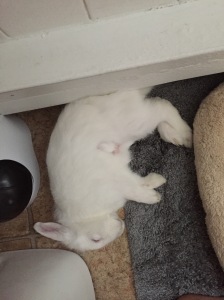
How to clicker train your rabbit to do tricks

Rabbits are really amazing creatures!

While people unfamiliar with the pets may consider them boring, bunny owners know they have a lot to offer.

They can be trained to use a litter box and learn to come when called. Rabbits can also learn tricks!

That’s right! Tricks are not just for dogs!

The bunny that’s most famous for doing tricks is Bini the Bunny. I’ve seen this rabbit dunk basketballs and paint masterpieces! Not every rabbit has this amount of talent, but you can still get a taste for tricks.

We’ll go over clicker training and how you can train your rabbit to do a simple trick.

What is clicker training?

Clicker training is when you get your pet to respond to a clicking noise. They associate the sound with a good thing (like a treat) and perform a desired action.

From there, you can replace the clicking sounds with specific hand gestures or verbal cues.

Some people have trained their rabbits to run in a circle, come when called, and jump onto couches – all using this method.

What can you use as a clicker?

You’ll need something to act as a “clicker.”

I personally just make a clicking sound with my mouth!

But there are also products out there that you can use that are handheld or can be used in your mouth. It doesn’t particularly matter what you use as long as it makes a sound that’s different than your rabbit would normally hear.

Here are some options:

What rewards should you use during training?

When training your bunny, you should use high value (aka their favorite) rewards.

This should be something they don’t get all the time but that they absolutely love!

Here are some examples:

Surprisingly, Baby loves pellets enough that that is a significant motivator. This is especially true now that I’ve limited his pellets to encourage him to eat more hay.
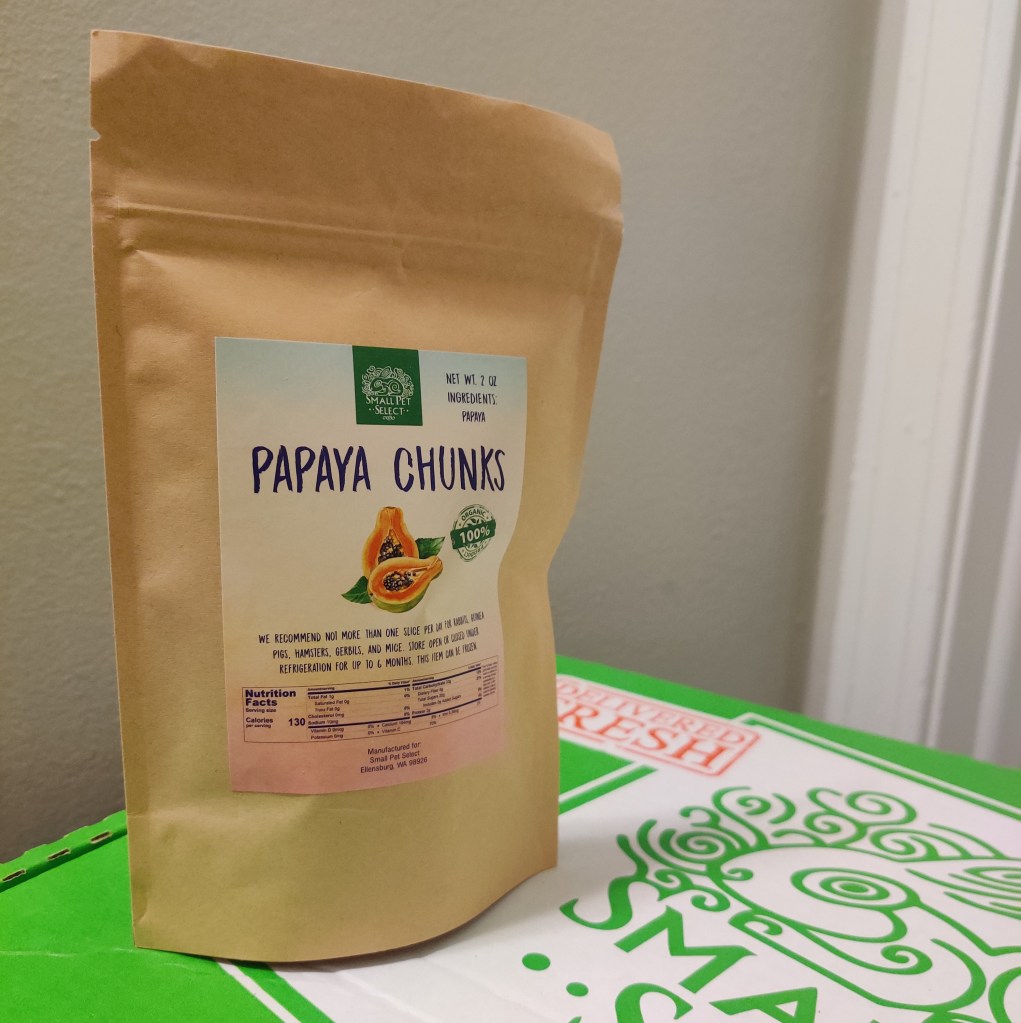
When training your bunny, it’s important to set aside all the treats you will be giving out that day. This will prevent you from overloading your rabbit with the unhealthy, sugary foods.

How long should each training session be?

I would let your rabbit determine the training session.

Each rabbit has its own attention span. When Baby has had enough, no amount of treats can make him do what I’m asking.

Make sure you stop the training when you can tell they’re “not having it.” This will keep the sessions fun, tasty, and effective.

A shorter, successful training is better for your bun than a long, drawn out session that feels like you’re bossing them around.

Running out of your pre-portioned treats is also an indicator to stop.

Typically, my training sessions are between 5-10 minutes.

How to teach your rabbit

For this example, we’ll be teaching your bunny how to stand on their hind legs on command.

To start out with any trick, you need to get your rabbit to associate with a clicker sound with a treat.

  1. Your rabbit does something you like. In this case, your rabbit stands up on its hind legs. Naturally, they will do it when they are curious about something high up. Baby does this when I’m getting his food in the morning. He gets excited and tries to reach up for them.
  2. When they do this, produce the clicking sound.
  3. Immediately give the treat.
  4. Repeat when they do this action again. I’d do this for a few days, so they begin to associate the sound with the treat and the action.
  5. Give the action a name. This can be a verbal signal, like “stand.” Or it can be a hand signal. When I was training Baby, I would hold my hand out flat above his head.
  6. When your rabbit does the desired action, say the verbal or hand signal along with the clicker and treat combo.
  7. Repeat this for several days.
  8. Once they get good at this, take away the clicker sound and just use the hand signal. It may confuse your bun at first, but hopefully it will be enough of a routine at that point that they will still understand the ask. If they do not understand, alternate between with the clicker sound and without the clicker sound.

Extra tips

  • Do not use negative reinforcement for clicker training. Focus on the positive rewards.
  • Do not give the treat if your bunny “messes up.” Just try again! Remember, this is an extra treat on top of their regular food, so they don’t necessarily need the treat.
  • Use only a moderate amount of treats so you keep it healthy.
  • Be consistent. Rabbits can remember the tricks once learned. But when they’re first starting out, you want to make sure training isn’t once in a blue moon.
  • Don’t force it. Some rabbits are trick obsessed and want those treats. Some rabbits will look at your attempts and scoff. Just respect your rabbit’s decision to not participate if that’s the case.

What tricks does your rabbit know?

Baby has learn a few tricks in our years together!

What has your rabbit learned? Let us know how you were (or were not) able to train your bun.

Note: As an Amazon Associate I earn from qualifying purchases. I get commissions for purchases made through links in this post.

cuzrabbits gets commissions from some of the affiliate links in this post. Support our education efforts by buying your pet supplies at Small Pet Select.

Bunny Beauty Content: Is your bunny scientifically the “cutest?”

Is your rabbit cute or ugly?

It’s a topic that can cause some tension in rabbit groups on social media. Some people, for example, have an aversion to REWs (Red-eyed whites), saying red eyes are too creepy looking on a rabbit. Others insist all bunnies are equally adorable! Or as they say, “Everyone thinks their rabbit is the cutest, and they’re all right.”

Well, scientists found a reason to find out if there really is a preference for some rabbits over others.

About the Study

In October 2019, researchers published the results of a survey they completed in Animals, an international scientific journal.

Their goal was to find out what type of rabbit people like best. This would hopefully explain why rabbits have been slowly bred to look different than their wild counterparts. The flatter, shorter faces that domestic rabbits tend to have, can lead to painful dental problems.

My own veterinarian has commented that Baby, my lionhead rabbit, is more susceptible to dental issues because of his face shape.

Researchers got back 20,858 online surveys from people around the world. Participants were asked to rate 25 rabbits based on their faces in selected photos.

What features do the cutest bunnies have?

Through statistical data, the researchers found these are the most preferred features:

  • Mildly flat faces
  • Non-lopped ears
  • Soft, medium-light fur
  • Generally shorter fur

This was a bit different than the researchers expected. The very shortened faces that are generally considered “baby-like” were not universally preferred. There were also a decent amount of people who disliked some of the rabbits that looked too fluffy.

When deciding whether a bunny photo was cute, how soft a rabbit looked had the biggest impact, and the shape of a rabbits face was the second biggest impact.

What can we learn from this study?

There’s a lot of aspects of domestic rabbits that are unexplored by science. We should all take this research (although a fun concept on the surface) seriously.

Governments and Researchers

There isn’t a lot of global regulations surrounding pet rabbits.

This is very different from rules about breeding and treatment of dogs. Because of all the evidence about the negative impact shorter snouts, the Dutch Government actually decided to end the breeding of pugs!

Face shapes can have an even more extreme effect on rabbits, but not enough research have been done to accomplish the same progress.

Breeders

Researchers suggested breeders take this data into consideration. Why breed rabbits to have medically dangerous flat faces when mildly flat faces are preferred by buyers anyway?

Rabbits with lop ears also tend to have more health issues, especially dental problems, because of their skull and jaw shapes. For the health of the domestic species overall, researchers suggested breeders focus on bunnies whose ears stand up, like Havana rabbits.

Bunny Owners

Pet owners and perspective pet owners can be more mindful about the power of the cuteness.

Despite campaigns aimed at thoughtfulness, rabbits are impulse buys for many. One study done in 2011 found out of 52 rabbit owners, 18% decided to buy the rabbit on the same day. It’s important to look past rabbits’ beautiful faces and understand the commitment.

Source

Harvey, Naomi D., et al. “What Makes a Rabbit Cute? Preference for Rabbit Faces Differs according to Skull Morphology and Demographic Factors.” Animals [Basel], vol. 9, no. 10, 2019. Gale In Context: Science, link.gale.com/apps/doc/A617714650/GPS?u=mlin_w_wilbrapl&sid=GPS&xid=f223e41b. Accessed 22 Jan. 2021.

Do rabbits drink more water from a bowl or a bottle?

This is something that has caused so much drama on bunny Facebook groups. I’ve seen people become absolute vipers in the comments section, tearing down rabbit owners on the “wrong” side.

So which is better for your rabbit? Some swear by bowls, claiming they encourage bunnies to drink more. Others insist their rabbits refuse to drink from anything but a water bottle. Some (although definitely in the minority) have turned to water fountains.

We’ll sort out the pros and cons of bottles, bowls, and fountains, so you can decide once and for all, what is best for your bun.

A Look at the Research

There are always the usual arguments for Team Water Bowl.

“Your rabbit isn’t getting enough water from a bottle.”

“Bowls encourage rabbits to drink more.”

But are they true?

I could only find two studied specifically related to rabbits. Most of the articles discussing the topic either cite no scientific sources or simply referred one of two studies, both from the same team at the University of Zurich:

  • A Study from 2010 (Tschudin et al. 2010a): This was a study that tested how water intake was affected when water was not readily available to rabbits at all times.
  • This study from 2011 (Tschudin et al 2011b): This study tested the 2010 study more thoroughly.

We’ll focus on the second, more focused study of bottles and bowls.

The parameters

Just because a study concludes something doesn’t mean it’s true. Researchers using the scientific method:

  • Make an observation
  • Ask a question about it
  • Come up with a hypothesis
  • Make a prediction about the outcome
  • Test the theory
  • Document the results

Different researchers doing the same study wouldn’t necessarily come up with the same results. That’s why so many studies are done on the same topic – to verify previous results.

It’s important to understand how the experiment or study was conducted.

In the case of the University of Zurich study, 12 adult dwarf rabbits were tested to see how different factors influenced their water intake – including whether they drank from bowls or bottles. This isn’t a very large sample size. As you probably know, each rabbit is vastly different in personality and preference. It’s tough to say the results of a study of a dozen rabbits should dictate what all rabbit owners should do.

The Results

The study ultimately found that “the drinker [aka the bottle] had no influence on water intake.”

But they still suggested recommended rabbit owners use a bowl. Their data found bottles had a “negative influence” when water access was restricted.

Better safe than sorry, I guess? But no rabbit owner I know is purposely only offering water at certain times.

Researchers noted, while drinking from water bottles didn’t necessarily make rabbits drink less, it did change their fecal matter. There was more dry matter, which a veterinarian writing about the study says is a “physiological water-saving mechanism.” So while they may drink the same amount of water, their body thinks there’s a shortage.

The researchers also suggested not putting the water bowl directly on the floor, so the water is more likely to stay clean.

Here are your water options

I’ve tried bottles and bowls on Baby, but not a water fountain!

The Water Bottle

There are two main types of water bottles that I know of. There are ones that have a metal ball at the tip and ones that have a small metal rod at the tip.

Pros

  • You don’t have to refill it as often.
  • You can set one up if you’re going on a one or two day trip without worrying about your rabbit running out of water.

Cons

  • Some brands end up developing a drip, which can cause a mess.
  • You need to check for air blocks that may prevent the water from coming through.
  • Bottles tend to develop green mold inside, especially if they’re exposed to natural light. This mold can be kind of difficult to clean.
  • You need some sort of cage or playpen to attach the bottle to, so this wouldn’t work as well for fully free roam rabbits.
  • Some rabbits may need to be taught how to use a bottle. You may need to spend some time showing them how to use the nozzle to get the water to come out.

The Water Bowl

You can find a lot more variety and cute styles if you go the bowl route, just because other, more popular pets like cats and dogs use them as well.

There are a ton of different designs and materials they’re made of. I suggest a heavier material like ceramic so your bun has a harder time flipping it over.

Pros

  • You can see the dirtiness more easily. This encourages you, the human, to clean the bowl and replace the water more often.
  • They’re more aesthetically pleasing (in my opinion).

Cons

  • Some bunnies relish the opportunity to flip their bowl, sending water flying everywhere.
  • It’s easier for fur and other things to get into the water. From experience, cleaning a food pellet or bunny poop that has dissolved in the water overnight is horrifying.

The sliminess that accumulates on the sides and bottom of the water bowl is called bacterial biofilm. The Cedar Pet Clinic in Lake Elmo, Minnesota explains this in the context of dogs and offers up a cleaning strategy.

The Water Fountain

I’ve considered getting Baby a water fountain, only because I’m sick of seeing hair in his water bowl (he’s a Lionhead) during shedding season.

Agriculture Victoria (a government agency in Australia) recommends having a water fountain for your rabbit. But they say it’s important to have another source of water around, just in case it malfunctions without you realizing.

Pros

  • Fountains have filters that can keep your rabbit’s water cleaner.

Cons

  • You can’t tell how much water they’re drinking on a daily basis, because the water continually circulates.
  • Most fountains have a wire that connects to an outlet. Kudos if you can stop a rabbit from chewing through the cord!
  • You’ll still need to have a backup water source.

Do what’s best for your own rabbit

At the end of the day, you’re the bunny mom/dad. You have to do what’s best for your individual fur babies.

Some rabbits like bowls. Some like bottles. Some like fountains.

Try all three if you want. But ultimately, do what you think helps your rabbit get clean water in their stomach.

Which method do you use? Let us know in the comments (politely)!

Stay Connected

Sign up for our newsletter through Substack. We’ll send updates about our latest blog posts and projects, so you won’t miss a thing!

Note: As an Amazon Associate I earn from qualifying purchases. I get commissions for purchases made through links in this post.
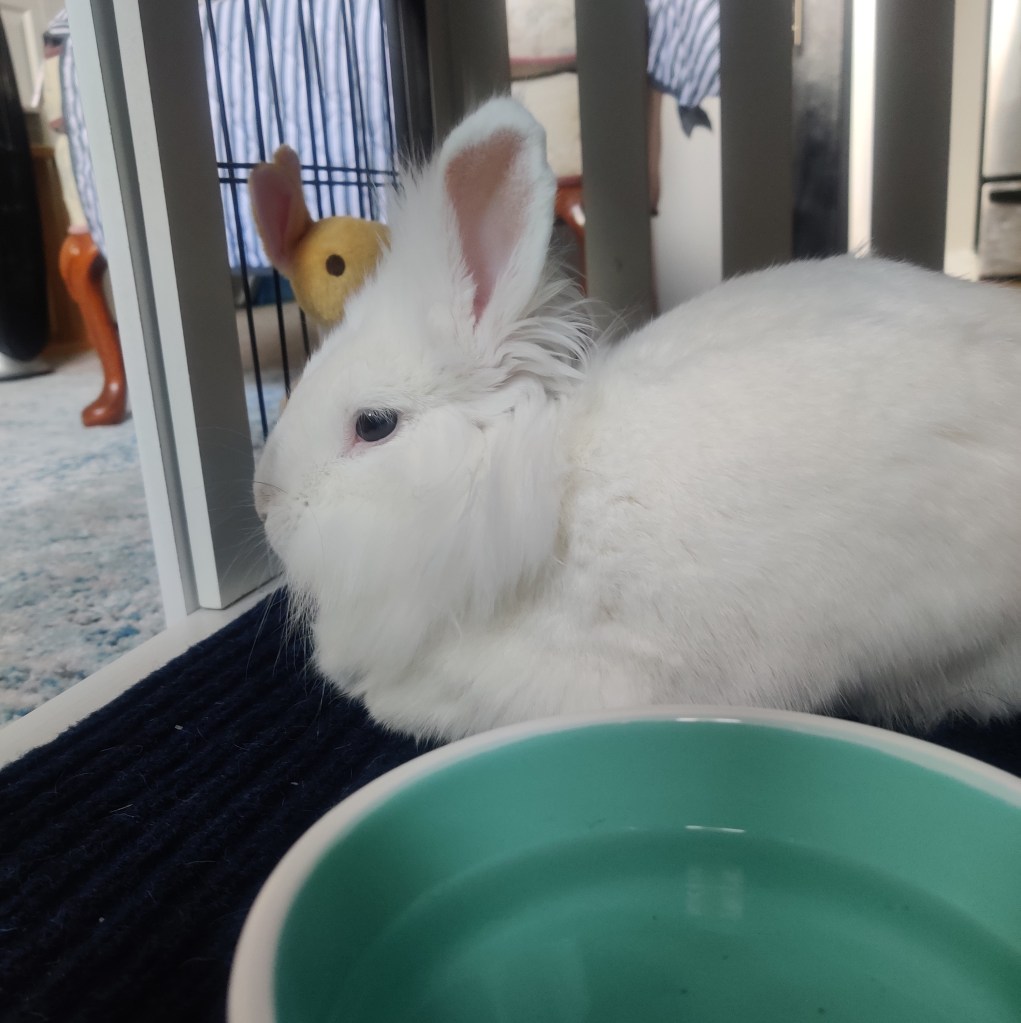
cuzrabbits gets commissions from some of the affiliate links in this post. Support our education efforts by buying your pet supplies at Small Pet Select.

A step-by-step guide for safely move with a bunny

Recently, I got married to my now husband. With that change for me, came a lot of changes for my bunny, Baby, too.

This included moving from my parents’ house to our new apartment!

I oftentimes see this question floating around rabbit Facebook groups: How do I move with my bunny?

The first thing to note is that each bunny is different! No matter what advice people on the internet (including me) give you, only you truly know your bun!

Some bunnies LOVE car rides, looking around at all of the scenery and thriving in the new stimulus. Others make you feel like you’re bringing them to their doom the second you open up your car door.

But as bunny parents, we know that sometimes a car ride and a change of housing is a necessary life change.

Here are some pointers for how we moved Baby!

The steps

Here’s the very top level basics for our process.

Again, it may be different for you depending if you’re moving a street over or across country.

For us, it was a 25 minute move. Adjust accordingly!

  1. Gather your supplies.
  2. Pack your bunny.
  3. Clean the original location.
  4. Drive to the new location.
  5. Set up your new bunny area.
  6. Introduce your bunny to the new area.

Gather your supplies

You’ll want to pack up and much as possible into the car before you put your actual bunny in the car. This will hopefully cut down on the time your rabbit spends in the car and will hopefully cut down on the stress with it.

Make sure you have:

  • Water bottle or bowl
  • Food dish
  • Toys
  • Hay
  • Pellets (optional to put in carrier as a distraction)
  • Hidey holes/houses
  • Litter box
  • Litter
  • Extra veggies (optional to put in carrier as a distraction)
  • Pet camera (if you have one)
  • Whatever flooring you have underneath your bunny set-up
  • Your cage/playpen
  • Any other accessories

Pack your bunny

The packing, cleaning, and supply gathering tends to happen somewhat simultaneously.

I’d say get down to your playpen, carpet, and litter box before getting your rabbit into a carrier.

I put Baby in the car, knowing that it would only be 5-10 minutes before the cleaning portion was done.

It’s important to only keep your bunny in the car for a short period of time if you are not there! There are too many reports of dogs and young children dying from heat exhaustion after being left in a car. Don’t let your rabbit be a part of that statistic!

Clean the original location

I was leaving my parents’ house, so it was important that I didn’t leave a hay, poop mess behind!

The same is true if you’re leaving an apartment!

Make sure to vacuum any carpet, scrub down any tile, and give a good air freshener spray for good measure. All in all, be courteous and get that security deposit back!

Drive to the new location

This is where you have to be in tune to your rabbit.

If your rabbit loves car rides, great! Throw in some hay and enjoy the ride!

If your rabbit is a bit more hesitant, try your best to make the ride more comfortable.

If you’re using a hard bottomed crate, put an old towel or dish cloth on the bottom. This will give your bun a better footing and make them feel more stable.

Make sure to put some food in the carrier. Hay can provide a snack and some nice bedding to keep them comfy.

Baby usually gets too blah during travel, but he’ll occasionally nibble on some hay or pellets I stick in there with him.

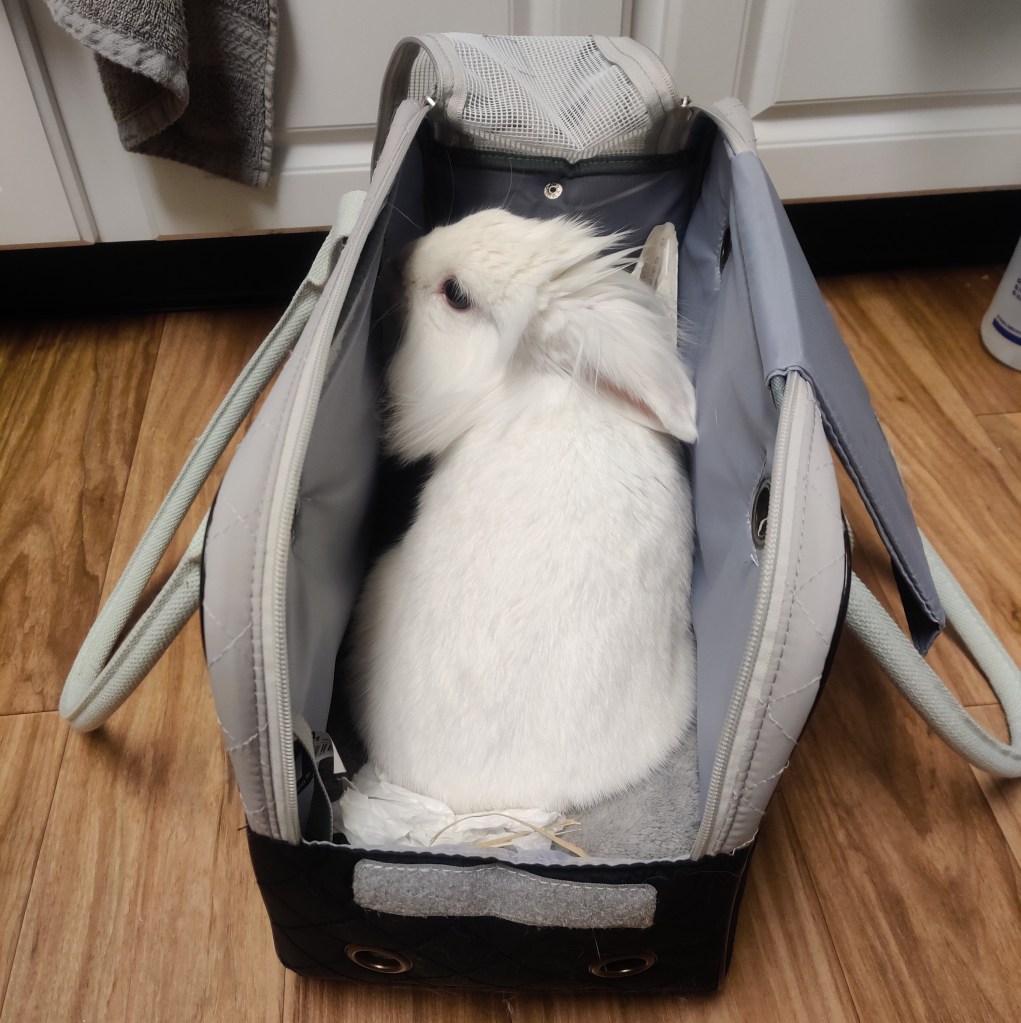
I’ve also found by many trials that Baby prefers a soft carrier with the top up. He won’t jump out, but I think the open top makes him feel less trapped. It also gives him more of an option to see me, and I can pet him more easily when he’s in the passenger seat.

A note for longer drives, you might consider stopping for a water break. Keep a bowl handy to fill with water to give during pit stops! The stop will also give your bun a chance to stretch their legs without all the bumps of the road.

Set up your new bunny area

Bunny proof, bunny proof, bunny proof!

Just like you likely did with your old place, take a look at the environment before releasing your bunny.

For us, that meant trapping Baby on the lava tile for a bit while we made sure the apartment was safe.

Your bun may not like this, but it could just save their life.

You can start by setting up their playpen or cage/run. Then they can be “imprisoned” there until you’ve:

  • Removed any loose, important papers
  • Checked for exposed wires
  • Put valuables in an out of reach place
  • Moved any toxic plants out of reach
  • Covered baseboards (if your bunny is the type to chew)
  • Blocked off the bottom of couches (if your bunny is the type to go under)
  • Blocked off couches altogether (if your bunny is the type to pee everywhere)

Not every bunny has the same tendencies. It’s important to remember, you may have to re-bunny proof once your rabbit tests your defenses.

Introduce your bunny to the new area

This could take some time.

Again, it’s important to take your rabbit’s personality into consideration.

Some rabbits need to be introduced slowly into a new area. Room by room or maybe let out in 30 minute intervals. Check their litter box habits. If they have a lot of accidents, you know they need more time to get used to all the new smells before having free reign.

Baby was fine after a few days.

At first, he went around, slowly sniffing everything. You could see him slinking around like a ninja, cautiously investigating every nook and cranny of the new apartment.

Once he’d smelled everything, things got back to normal. We had gotten back into a daily routine, which helped a lot.

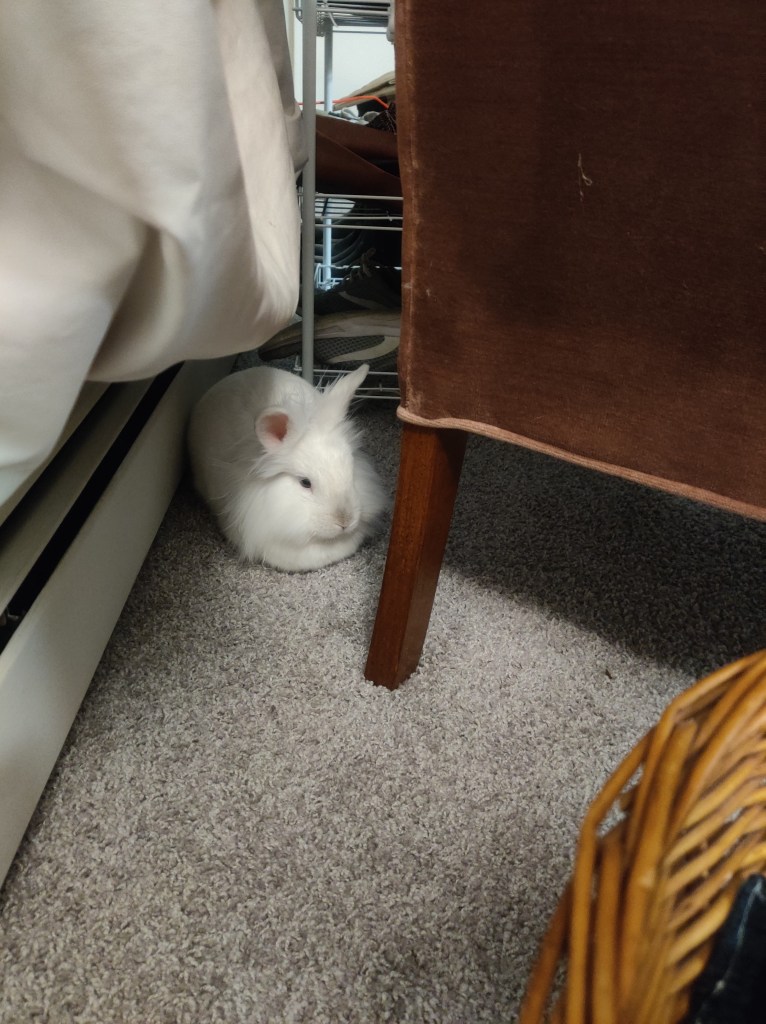
He even found his new nap spot, underneath a chair and next to a radiator!

Let your bunny be your guide

Pinocchio let his conscience be his guide.

You should let your bunny be your guide!

Generally, bunny are more resilient than you may think. We often get stuck in the “worried bunny parent” vibe. But as long as your bunny keeps popping and eating, and you make your bun as comfy as possible during the ride, everything should be fine.

If anything, you can call a vet for advice. Or bring a friend along for the ride to calm you down.

Take the ride at your bunny’s pace.

Note: As an Amazon Associate I earn from qualifying purchases. I get commissions for purchases made through links in this post.

How I spend my day quarantining with my bunny during COVID-19 lockdown

COVID-19 has changed our world forever.

While hoomans worry about wearing masks, washing hands often, and socially distancing from friends and family, there’s one group who’s having the time of their lives – pets.

I have never spent so much time with Baby, my white angel. Working from home has put me in his space for hours longer than I’d normally be there (and believe me, that was still a lot of time)!

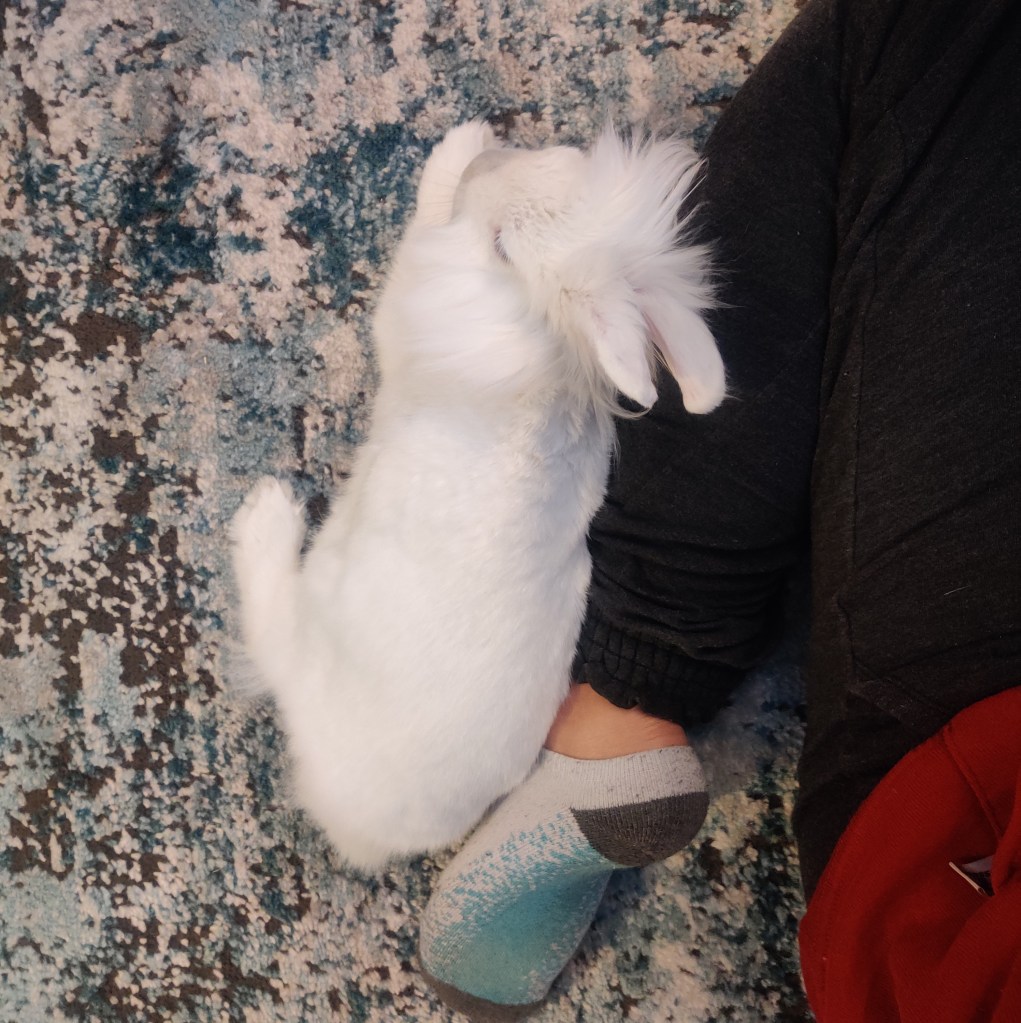
He has been absolutely loving the attention and has definitely reciprocated. In the past few months he has started licking me excessively (never did that before) and even flopped onto my stomach as I was lounging on the couch.

Life has become very consistent, since I have nowhere to be but home!

Here’s our schedule and how we’ve become more integrated in each other’s lives.

Morning

7 a.m.

I wake up and brush my teeth!

I usually multitask at this point and post to our Instagram and Facebook pages.

7:15 a.m.

At this point I’ve awakened myself enough to get some coffee. Baby can typically sense I’m getting ready to come down and is very antsy!!!

7:20 a.m.

Baby explodes with energy as I walk down the stairs!

I put my coffee down and open up the playpen door. Together, I walk and he hopes weaving in and out of my legs to the corner where his pellets and treats are kept.

Since he tends to eat too fast and was previously warned by the vet about obesity, I make Baby work for most of his food. We practice the stand command, circle command – occasionally mixing in jumps and tunnel runs. He gets a mouthful of pellets for every completion.

Once we’re done, I take a small bit of pellets and walk over to the couch and my coffee.

By the time I get there, Baby is already on the couch. I sit down and give him some more pellets.

I pet him for the next hour while on my phone, reading, or sipping coffee.

Sometimes he gets up to go to the bathroom, drink some water, or do zoomies.

8:20 a.m.

I refill Baby’s water, add more hay to the rack, and change the litter box if it needs it.

Being in his space makes Baby incredibly annoyed, but it must be done!

8:30 a.m.

This is the official start to my work day.

I usually spend the first part of the day downstairs on the couch with a little TV tray to rest my laptop on.

Baby does his own thing, generally either coming over for pets or exploring the surrounding area.

10:30 a.m.

I get up to get some breakfast.

Of course this is extremely interesting movement to Baby, as I have to walk through the treat/pellet corner to get to the kitchen.

He sits at the bottom of the stairs waiting for Breakfast Part II.

I typically bring down a few romaine lettuce leaves and feed them to him in small chunks I rip off.

Then it’s back to work and Baby does his own thing.

Afternoon

11:45 a.m.

This is when Baby’s afternoon nap starts.

By this time he has completely tired himself out and crawls into the bottom of his cat tower. He literally curls up into a ball, and it’s the cutest thing!!!!

12 p.m.

I have lunch and try not to disturb Baby too much.

12:30 p.m.

I quietly move my laptop upstairs so I don’t disturb Baby during my afternoon work calls.

3 p.m.

Depending on the weather and Baby’s energy level, I sometimes take Baby out for a walk in his pet stroller.

We just go to the park around the block.

He alternates between being utterly fascinated with his surroundings and completely bored.

3:30 p.m.

I “leave” for work again, while Baby rests up and munches at hay.

Night

5:30 p.m.

By this time, I’ve wrapped up my work day.

I can fit in a few chores, maybe a run for essentials at the grocery store, before dinner.

6:30 p.m.

After dinner, I come downstairs to hang out with Baby again.

Depending on his mood, Baby may still be resting at this point, and I have time for other chores or activities.

The rest of the night is spent petting Baby, looking at Baby, taking cute pictures of Baby, etc.

11 p.m.

This is when I usually start to pretend I’m actually going to bed on time.

I check Baby’s water and hay, before closing the playpen and wishing Baby a good night!

What’s your bonding secret?

Overall, a very long and fruitful day sent with the bun I love!

Every pet parent bonds with their babies differently!

Let me know what special ways you and your bunny connect!

Medical Issues and Money: Should I take my bunny to the vet?

It happens to us all.

You look at your bunny and notice something is not quite right. You panic a little, but head to the bunny community online for support. After a few keyword searches in some Facebook groups, your fears are realized. Off to the vet!

Then the vet calls you in. Your fur baby is perfectly fine – except for maybe one minor thing that never warranted the drive out.

That will be $70+ please.

Here’s why that bill is worth it.

You’re not an expert

Bunny owners are trained by a plethora of articles to keep a close eye out for their rabbit’s health.

As prey animals, rabbits tend to hide their illnesses. It would be deadly for a fox or hawk to find out their leg is a little bruised or they have some ear mite that’s preventing them from being at the top of their game.

For hooman parents, that means slight changes could mean big trouble.

  • Poop analysis: A change in their poop could mean they’re ingesting too much of their fur, not getting enough hay, having a digestion slowdown.
  • A tilted head: When a rabbit consistently positions their head to one side, it could mean they have a parasite.
  • Head shaking: Excessively, this could mean your bunny has ear mites.

And that is just the start!

It can be easy to feel like you’re overreacting. But in the end, this is the life of your child we’re talking about.

Sometimes you need a rabbit whisperer

We had a rabbit named Avalanche (RIP), a very shy, white lop-eared bun. Over the course of her life, she had many ailments – definitely the most medically needy bunny we’ve had.

One day, she started barely eating. My whole family was worried and couldn’t figure out what was wrong. She had plenty of hay, pellets, and lettuce available to her. We would occasionally give carrots as treats.

After a vet examined Avalanche, the bunny whisperer had a startling conclusion.

She wasn’t diseased.

She had no broken bones.

She wasn’t in pain.

What was the matter? She didn’t have enough variety in her life. Avalanche wanted more greens – the expensive kind.

It was that simple. We went the the grocery store and added some pizzazz to her diet. She was fine.

While we joke she was a picky princess, we probably wouldn’t have figured it out on our own. She could have died from stubbornness instead of living a long, happy life!

The money may be worth the reassurance

More recently, I had a scare with Baby, my white lionhead son.

I had been monitoring him for several weeks. The vet had told me he was overweight and needed to eat more hay to make sure his teeth didn’t become overgrown (Lionheads are prone to it because of their face shape).

Over the next two months, I started only giving pellets as treats. This encouraged Baby to eat A LOT more hay, more than he’s ever eaten daily in his life. I started giving him more romaine leaves, fed by hand, as a supplement for the excitement that is pellets.

But his stomach started gurgling.

I would give him belly rubs to try to stop the gassy-ness. And I stopped giving him romaine lettuce in case that was what was bothering his stomach.

Then I noticed Baby’s poop was getting to be gigantic and oval-shaped. Definitely not his usual.

After hours of research online and in Facebook groups, I was convinced he had megacolon, a rare genetic disease that affects the digestive system.

I brought him to the vet and anxiously waited outside in my car (ahh, pandemic social distancing rules).

My stunning view of the vet office

The vet called me an hour later. Baby was perfectly fine, even eating the hay I had put in his carrier! He had lost about a pound and a half since the last visit.

I learned several important things because of that “wasted” vet visit.

  • Baby did not have megacolon.
  • I needed to start feeding him a QUART of varied veggies A DAY! Not what I expected.
  • Gurgling stomachs are just digesting – not necessarily a sign of GI Stasis. Being constantly with him (working from home) just made me notice it more.
  • Sometimes poop looks different.
  • It’s not about weight, but about health. You don’t want a chubster bun, but you also don’t want to feel bone. It might be a good investment to get a baby scale if I was actually that worried about the numbers.

My worries were gone after that visit, and I learned some valuable information. Considering my fears had been mounting for about two weeks, I’d say it was a good investment.

Create a vet bill plan

Not everyone can afford these random vet visits. But it is something you should prepare for, especially if the visit unearths a pricey medical problem.

Make a budget

My strategy is to budget out a certain amount of money each month for “Emergency Rabbit Costs.” This came in handy when Baby sprained his front paw! I had enough money to cover it.

Besides emergencies, annual pet visits are around $70, something I can also budget for.

Pet insurance

Other people have recommended Nationwide pet insurance. The company has an Avion & Exotic Pet Plan that covers medical treatments and surgeries.

Before purchasing, I would make sure to read up on what is covered and what isn’t. From what I’ve read on Facebook, some people have been burned because they didn’t realize a certain, specific thing wasn’t covered.

Ask the bunny community

There are a lot of really nice, caring people in this world.

Consider joining the Bunny Vet Bill Help Facebook group before a disaster strikes. Make sure to read the description so you understand what members can help with. And of course, if you join, try to donate to another person’s cause – even if it’s just a couple dollars.

Stay Connected

Sign up for our newsletter through Substack. We’ll send updates about our latest blog posts and projects, so you won’t miss a thing!

Rabbit Noises Explained: How to become fluent in bunny body language and sounds

They may not be able to bark or meow, but bunnies are anything but quiet!

Here is a guide to understanding the noises your fur baby is making!

Stomping

The situation

A: Your house is on fire. You are being robbed. There is a giant thunderstorm. There is a dangerous human around.

B: You’re not giving your bunny a treat at the preferred time and place. You did not pet your bunny when requested.

The why

A: As you may know, rabbits are prey animals that can’t talk to each other like humans or more vocal animals. Instead of telling their friends (aka you and your family) that there is danger around, they are stomping at your to get to your attention.

Comfort your bunny with treats or investigate the problem. In some instances, bunnies have saved their owners from fire by stomping!

B: Bunnies can be very particular and demanding creatures. Many pet parents joke that they are really just bunny slaves. This is why! That bunny stomp could be them yelling at you, “Hellllloooooo, where is my treat???”

Pamper your bunny or ignore it so you don’t spoil him or her. Your choice!

Bunnies may scratch you if they are upset with something you are doing

Grunting

The situation

You are going about your business. Maybe you’re cleaning your bunny’s cage, or reading a book on the floor to be closer to your furry friend.

Your bunny comes over and grunts at you! This sound may be accompanied by scratches or little bites.

The why

This is your bunny’s way of yelling at you. Whatever you are doing – WRONG!

You’re trying to give a lame (anything but their favorite) treat…

OR your legs are in the way of zoomies and binkies…

OR you’re touching their stuff after they arraigned it just the way they like it…

OR you tried to pick them up (HOW DARE YOU)…

OR you tried to cut their nails (THE AUDACITY)…

OR any other number of horrific offenses to rabbit-kind.

Honking

The situation

Your bunny is running around you while you are sitting on the ground, walking, or just standing in the kitchen. Then, all of a sudden, out come these duck noises or honking sounds. They’re quiet, but still definitely noticeable.

You may have noticed your bunny has been getting a little more aggressive lately or at least more sassy. Your bunny might even have humped you recently.

The why

It may be time to neuter your rabbit. Boy bunnies who haven’t been spayed will oftentimes honk and circle when they want to mate.

Don’t take it personally. Although you may be a hottie, this is your bunny’s natural instincts coming through.

An alternative answer

If your bunny has been neutered recently, it may take some time for these behaviors to go away. It may have become a learned behavior.

It’s likely that you thought the honking and circling was adorable (maybe not so much the humping), which made you give your rabbit so much attention when they did these things. Your rabbit might now associate these noises or actions with getting that extra PG lovin’. Baby still circles me when he wants a treat or pets, but the honking went away pretty quickly.

Bunnies will sometimes grind their teeth if they are enjoying being pet.

Teeth Grinding

The situation

You’re petting your bunny, and…. ewwww why is he making horrific sounds with his teeth???

The why

This a rabbit’s way of purring. Consider it a compliment! You are a great bunny petter! As you get to know your bunny well, you’ll figure out the sweet spots.

Baby particularly likes his head pet. As in only his head. Like just take both hand and cover his head completely.

BUT… if your rabbit is grinding his teeth often while not being pet or eating food, it might be a dental problem. Learn how to identify potential issues and know when to see a vet.

Scream

Note: I have never heard this sound and I hope I never will. You may hear a bunny scream when it is in mortal danger. Come to that bunny’s rescue and go to the vet if necessary.

Stay Connected

Sign up for our newsletter through Substack. We’ll send updates about our latest blog posts and projects, so you won’t miss a thing!

Pros and cons: Is owning a rabbit the right decision for you?

Deciding whether or not to get a rabbit can be a pretty tough decision. There are a lot of different factors to consider. A rabbit is certainly not for everyone, but they make adorable additions to the family.

These lists are not even.

Being a bunny lover, I’m pretty partial to the pros. But the cons can be real deal breakers for people. Know yourself and what is important to you in a pet.

Pros

rabbit snuggled in blankets
Having a rabbit in your family means having an instant cuddle buddy all the time!
  1. Adorableness: Rabbits are sooooooo cute. They’re perfectly Instagramable eye candy!
  2. The rewarding connection: There’s just something about earning a rabbit’s trust that is simply magical. Rabbits are naturally prey animals, so they don’t just cozy up to anyone. So when you’re petting your rabbit, and she starts licking you, it feels like you’re The Chosen One.
  3. The perfect bingeing pal: Rabbits are indoor pets, so they’re happy to stay inside with you all winterlong. For Baby and I, it meant binge watching the entire Gilmore Girls series on Netflix. Just a girl and her bun hanging out together ❤
  4. Litter training: Similar to a cat, rabbit can be trained to use a litter box. It means you don’t have to let them out to do their business when it’s raining or when there’s a snowstorm. Some pet parents recommend changing the litter box once a day with shedding top offs, while others settle for every couple of days. It’s as clean as YOU keep it. So if it starts to smell, whose fault is it, really?
  5. Teaching tricks: Rabbits can learn to do tricks. The best example I’ve seen is Bini the Bunny, but you can teach small tricks too. Baby and Pepper can both come when called. In the past, I’ve taught rabbits to stand up on their hind legs on command.
  6. Being trained: Your rabbits often train you! Baby once tricked my mom into petting him for two hours straight by giving little nudges and encouraging nips when she stopped petting him. He has also trained me to give him a carrot every day as soon as he hears me wake up. 
  7. Independence: Rabbits are the best combination of dogs and cats; oftentimes playful like a puppy but can do their own thing like a cat. You can go on a day trip and not have to worry about accidents at home. You don’t have to race home to let them go to the bathroom. You can go on a weekend trip if you stock rabbits with the essentials. Although bunnies love a good cuddle, they don’t need your attention 24/7. It offers flexibility.
  8. Long life: Bunnies are not like goldfish you buy at a carnival. Without illness, an indoor rabbit can live to be around 10 to 15 years old. You’ll have time to really bond with the bunny and have a long time partner in crime.  
  9. Bunny habitat: It is so much fun figuring out a setup for your bun! Even if you free roam your rabbit, you can make cardboard castles, box tunnels, etc. Or you can go fancy and convert a dresser into a bunny bungalow. See Pinterest for inspiration!
  10. The bunny community: You’ll be able to join other pet parents online, sharing cute pictures and getting advice. There are Facebook groups and plenty of bunny Instagram accounts (like ours!

Cons

rabbit chewing on newspaper
Rabbits are destructive, so you have to give them plenty of toys and activities to keep them occupied.
  1. Not a dog/ long bonding times: While some rabbits will follow you around and go for walks on leashes, they are NOT dogs. They won’t give the same burst of affection that dogs will. Bunnies are subtle creatures. You have to really make an effort to learn their language and bond with them. Once you do, you’re golden! This long-term bonding strategy is not for everyone.
  2. Lots of attention: While rabbits enjoy their independence, they do need a lot of love. That’s petting, cuddling, and just generally hanging out together. It is really, really nice, but you have to set aside the time for the pet you dedicated yourself to.
  3. Extensive care: A lot goes into making a bunny life buntastic! Bunnies need their nails trimmed, plenty of fresh hay and water, and toys. They’re work, just like literally any other pet.
  4. Expenses: It’s important to consider the cost of owning a rabbit – and not just the actual adoption fee. Over time, rabbits can become very expensive. Medical emergencies can come up, you may have to buy a bunch of toys before finding one your bunny actually likes, and food isn’t always cheap. Make sure you know what you’re getting into!
  5. Lots of Shedding: Like every pet that is not a naked mole rat, rabbits shed hair. It falls off in varying amounts depending on the season. They need to be pet/ groomed every day (but some breeds may require extensive brushing) to get rid of the loose hair. If you don’t, all that hair can stay in their stomachs. Rabbits can’t throw up hairballs like cats, so it can cause health issues. Basically, lint rollers will become your best friend. 
  6. Bunny-proofing everything: Each rabbit is different, but each have a bit of a destroy-your-house instinct. They’re like little kids who know they’re doing something wrong but still do it. Some bunnies will chew your cord and phone chargers. Some will bite at your wood baseboards. Some will rip up your carpet. Some will eat the buttons on your TV remote. The list goes on and on and on and on and on. As a pet parent, you will have to monitor your bunny’s behavior and make necessary changes. This takes time and work. Full warning: no matter what you do, something will be destroyed eventually.
  7. Weirdness: You’ll end up being that weird person with a rabbit. Many people will say things like, “Why don’t you just get a dog?” or worse, “Lol rabbit tastes good.” I’ve heard and read the nastiest and most insensitive things. You’re going to have to find a way to deal with that, either by ignoring it or venting to the rabbit community.

Did I miss any pros or cons? Let me know in the comments!

Stay Connected

Sign up for our newsletter through Substack. We’ll send updates about our latest blog posts and projects, so you won’t miss a thing!

So you want a rabbit? Here is an ethics comparison on where you buy

So you’ve thought about getting a rabbit for weeks. You’ve researched the pro’s and con’s of adopting a rabbit. The bunny is not just some Easter Bunny gift, you’re getting on a whim. You’re looking for a 10-13 year friend! Now, where do you get one?

An Animal Shelter/ Foster Home

bunny sitting down
Pepper was adopted from an animal shelter and was loved for the rest of her days.

EXPENSE: $$

MORALOMETER: 5 Thumbs Up

This is one of the more traditional ways to adopt a rabbit. Many people in the rabbit community consider it the best method, because animal shelters generally know more about rabbit welfare. Some are better than others though. I’ve adopted from some shelter who keep their rabbits in small metal compartments stacked together. But I’ve also seen shelters give bunnies whole pens to roam and play around.

Animal shelters will spay/neuter the rabbit ahead of adoption. That means the adoption fees will be higher. I’ve seen $60-$80 for one rabbit and around $120 for a bonded pair. That’s around what you would pay a vet anyway, so don’t feel like you’d be getting a bad deal. An extra bonus is that you don’t have to go through the trouble of finding your own vet.

The BIG BONUS is that some animal shelters or foster homes will socialize your bun for you! It’s not a perfect system, but they’ll oftentimes litter train the bunny. Foster parents will give bunnies lots of pets, so they’re a little more ready to be cuddled by new pet parents.

A Pet Store

EXPENSE: $$

MORALOMETER: 3 Thumbs Up

This is a point of contention in the rabbit community. Some are completely against buying a rabbit from the pet store. The bunnies typically come from breeders. But the biggest argument against pet stores is how they house the rabbits BEFORE they’re adopted. Oftentimes, the rabbits are only fed pellets (way too much) and do not have hay readily available for munching.

I agree. Terrible stuff.

But I would caution you before judging too hard. There is a pet supply store in my area that specifically tries to help rescue rabbits. Although their living space is not ideal, hopefully exposure with the public will give those bunnies a home faster! Plus, the employees are wizards with nail clippers and are so so nice!

Pet stores typically charge the same amount as animal shelters, but it pays to check whether they’re sexed properly and actually fixed. For every good pet store, there’s one that’s…… meh.

A Craigslist Ad

EXPENSE: ?

MORALOMETER: 3 Thumbs Up

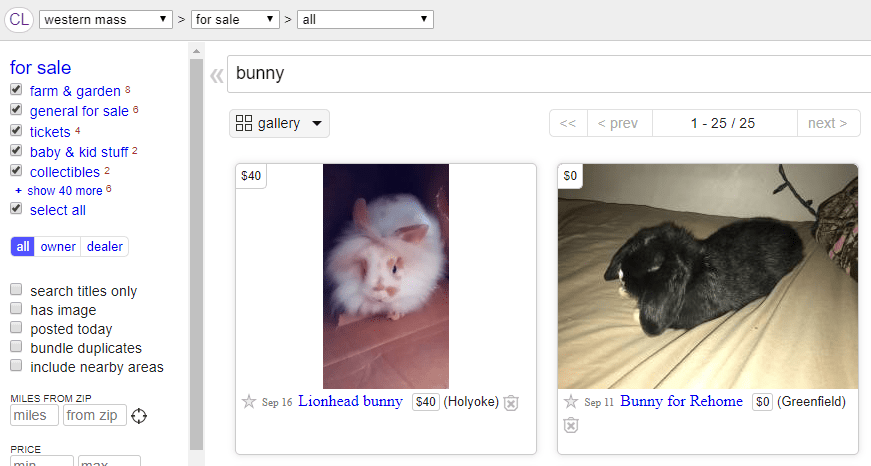
This is method is also pretty controversial. There are some people out there selling meat rabbits (gahhhh) and breeders trying to sell rabbits to people who don’t know how much love a rabbits need.

craigslist ad for bunnies
Prices can vary on Craigslist. Some owners request a rehoming fee, while others want to get rid of their pets asap.

But some people genuinely want a good home for their buns. They’re either moving to an apartment that doesn’t allow pets or overwhelmed by the responsibilities of caring for a rabbit. Either way, I can’t judge them. They know they will not be able to handle being a pet parent and would rather give their rabbit a chance at a loving home.

Rabbits listed on Craigslist or other selling sites can range by A LOT. Some give rabbits away for free, because they just want to get rid of their pet asap. Others price their rabbits at around $60 as a “rehoming fee” to make sure the rabbit actually goes to a good home. Still others are trying to make a quick buck and gauge you.

I think it’s up to your own discretion with this one. Here’s my success story, proving that bunny love can come from the oddest circumstances.

A Breeder

EXPENSE: $$$

MORALOMETER: 1 Thumbs Up

Getting any animal from any breeder seems to be the cardinal sin of pet ownership. Sometimes the animals are overbred and have “bad” genetics. They’re generally overpriced.

Personally, I can’t blame people for going to breeders. If you have the money, great! If you want a particular breed, great! In my opinion, these are still rabbits, who were born to breeders through no fault of their own. All bunnies are special and deserve love!

A Friend/ Family Member

EXPENSE: $

MORALOMETER: 5 Thumbs Up

This, I think, is one of the best options for getting a bunny. It’s similar to the Craigslist option, but you’d be helping out people you actually know. The friend or family member may be able to give you any extra supplies they have, and they’re probably more willing to give you a deal. And similar to the animal shelter option, the previous owner will be able to give you a sense of the rabbit’s personality. If you’re pretty close to the person, you may even know the bunny already!

My family got our first two rabbits when our aunt’s bunny got pregnant. We loved them from babies to elderly buns!

Do your research and decide for yourself!

Let me know which option you used to find the bun of your dreams. Leave a comment!

Stay Connected

Sign up for our newsletter through Substack. We’ll send updates about our latest blog posts and projects, so you won’t miss a thing!

The Great Gender Mixup: Why it’s important to get a good vet

It was the classic gender mixup, which apparently happens more often than I had thought. Baby’s previous owners had told me the young rabbit was a girl, which is probably what they were told by a pet store or breeder.

I spent almost a month mulling over different names, and finally settled on Baby Anne. It was in honor of my favorite book character, Anne of Green Gables. But then, my family and I started noticing some warning signs.

Boy or Girl?

It started after my rabbit and I became friends. At first, Baby was jittery and was cautious about leaving his cage. After a few weeks, the bun was more comfortable with me and loved hopping around the living room. The hopping gave way to other habits.

one rabbit checks out another rabbit
Baby and Pepper had an interesting first meeting and proceeded to grow their love/hate relationship.

The rabbit started running circles around my feet and making little honking noises. I found it so cute and thought he was just really excited to see me. The honking was odd, but I brushed it off. Baby’s behavior started to get really annoying though, when he started mounting my arm. From my past experience bonding rabbits, I knew even girl buns mounted to establish dominance. It was clear that the previous owners had not fixed the rabbit, so it put it on my to-do list.

Baby behaved even worse when I brought him with me on a visit back home to my parents’ house. My sister has another Lionhead rabbit named Pepper, who happens to be a girl. One day, while we were all home, we let them both out to see if they would get along. In retrospect, it was a horrible idea! They immediately started fighting. Baby started mounting Pepper (who is fixed) from the front, which can be very dangerous for rabbits. It’s easier for them to get hurt because of the easy biting access. We separated them. At that point, my mom shared her suspicions with me. Maybe Baby Anne was a boy?

Suspicions Confirmed

When I got back home to New York, I scheduled a visit to a local veterinarian for an initial look. The vet I chose mostly treated dogs and cats, but she said they did take in rabbit patients. The first appointment went smoothly. I shared my concerns with the vet, listing off the various incidents. She reassured me some girl rabbits can be quite territorial, so the behaviours could stop once the surgery was done. Baby Anne it was.

Then came the actual surgery a week or two later. With much nervousness, I dropped Baby off at the vet and headed off to work. The office told me the procedure would be several hours. But I got a call from them about an hour later.

Vet: “Ummmm, so I have some news for you.”

Me: “Yesssss?”

Vet: “Baby Anne is actually Baby Andy.”

rabbit has to wear a modified baby onsie
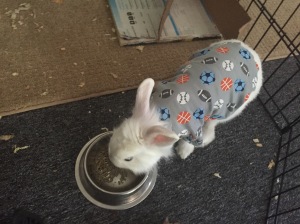
Baby had to wear modified baby onesies for about two weeks as he recovered from surgery (so he wouldn’t bite at the stitches).

I was furious. Vet appointments are not cheap. Almost $80 for them to tell me the wrong gender. I love Baby either way, but the incompetence of a vet that “sees rabbits” was disappointing. It can be very difficult to find care for rabbits and other small pets, and I thought I had landed a good one. 

It had been several months since I had brought Baby home, so he was already used to his name. For the most part, I had shortened it to Baby when I called him, so that wasn’t too big of an issue. I did not take the vet’s name suggestion, mostly out of spite. 

Instead, I went with Baby Man. Dumb name? Maybe. But I thought it was a good way to make light of the story, while  emphasizing the change to my friends and family.

Lessons Learned

The stressful mixup taught me to research veterinarians before settling. Check with other pet owners in your area. Read reviews. If there aren’t many options, I’d recommend traveling to a reputable vet. Some just don’t cut it. If they can’t take the time to properly sex a rabbit, think about what would happen in a real rabbit health crisis!

rabbit has spot shaved from neuter surgery
The vet had to shave a spot of Baby’s fur to do the neuter surgery.

I love my rabbit, boy or girl. But it’s much better knowing which he is and being able to rely on a good vet.

What’s the hardest lesson you’ve learned as a pet parent? Let me know in the comments, so we can learn together!

Stay Connected

Sign up for our newsletter through Substack. We’ll send updates about our latest blog posts and projects, so you won’t miss a thing!