Losing Baby was one of the most difficult things I’ve experienced in my life. For a long time, I was lost, and sometimes, I feel like I still am.
To help me get through the loss, our family ended up fostering two rabbits and a cockatiel. We ended up taking a break from pets for a while as we focused on our human children and healing.
Getting the Itch
After months and months, I still felt an emptiness. Aside from my college years, I’d lived with a pet in the house since I was in fourth grade. It just didn’t feel right to not have a pet as a companion.
So I started looking.
Almost every day, I’d hop onto PetFinder to see what was out there. But none ever really jumped out at me.
Until I saw a profile for a sad looking tan lop.
I sent the page to my husband and we decided to go to the shelter an hour away to see him. We wanted to be 100% sure he was a good fit for our family.
The Shelter Experience
We got to the shelter and noticed right away how small the place was.
The shelter primarily serves dogs and cats. They had a decent sized cage in their front office for housing the rabbit. I was shocked to see this arrangement because rabbits are prey animals. They certainly wouldn’t enjoy a busy lobby, constantly hearing TVs and barking dogs.
The workers brought us into a room with a bench to see the rabbit outside his cage. My husband, two toddlers, and I crammed in as best we could but then decided to take turns in groups of two.
The rabbit was scared, hiding in the corner under the bench. But he let us pet him and seemed sweet.
My husband and I ultimately decided we had to take him. It would have been too sad to leave him in an environment we knew was not suited to bunnies.
After less than ten minutes of paperwork, we walked out with our new family member!
The Bunny’s Backstory
We asked the workers about what they knew about this rabbit’s life before going to the shelter.
They didn’t know much but said the rabbit was an owner surrender. The previous owners just couldn’t take care of him anymore.
The rabbit did seem well-loved though. He came with his own carrier, food containers, multiple bags of treats, and a puzzle feeder.
Naming Our New Bunny
My husband and I brainstormed names on the drive home.
We decided we wanted a classic name, like one I might find in one of my books (I read a lot of Jane Austen and Robert Louis Stevenson).
We ended up choosing the name Henry!
It was the perfect choice for him, and as a bonus, my eldest son sounds adorable pronouncing it. The way he says it almost sounds French!
Learning As We Go
A new rabbit means relearning and reevaluating everything we thought we knew about bunnies.
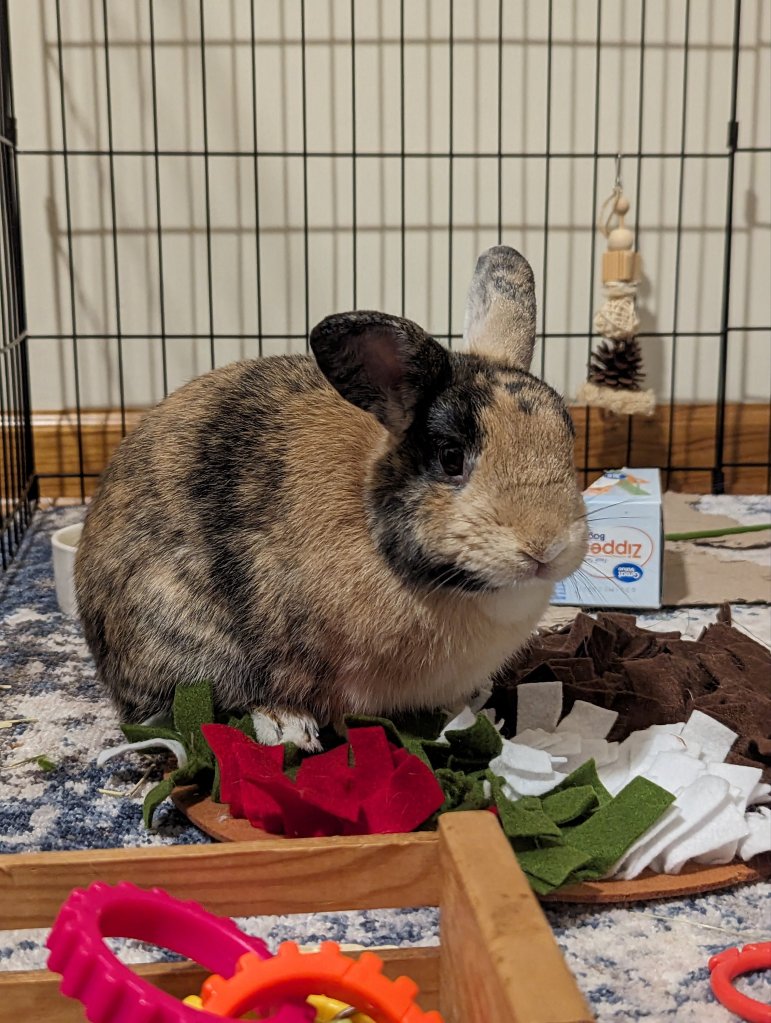
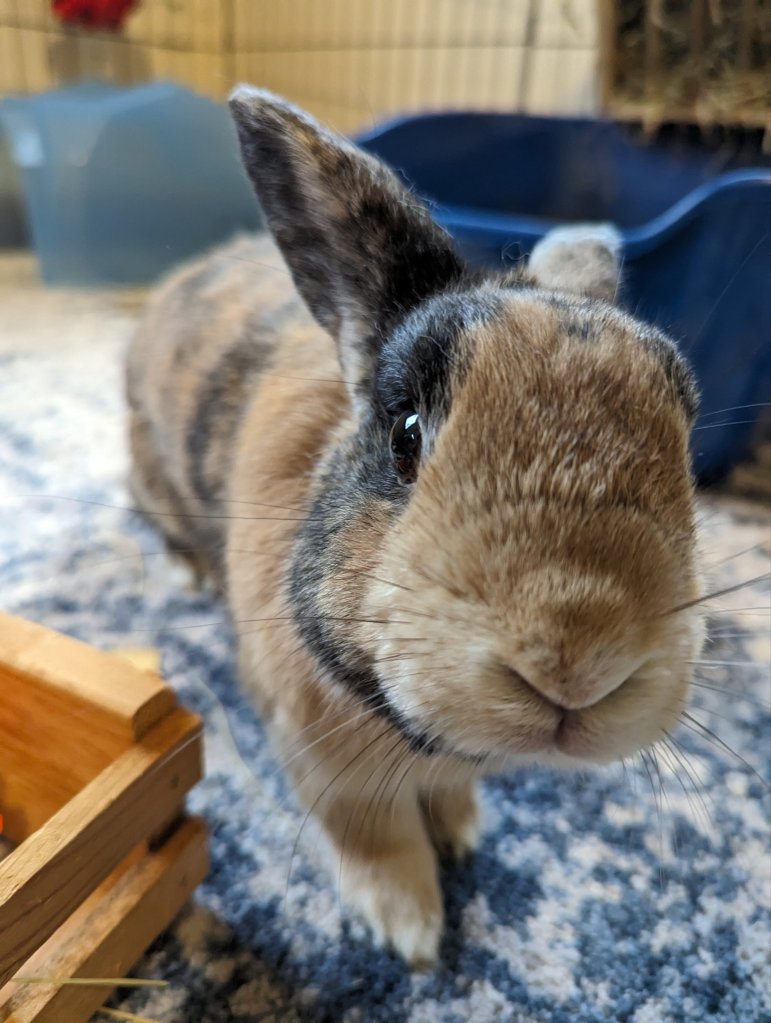
Hamlet, an adult harlequin bunny, has arrived at Baby’s Bungalow!
He has definitely proven to us that all rabbits have totally different personalities, just like humans. While our first foster was a young bunny that didn’t quite feel comfortable with strangers, Hamlet knows exactly what he wants and will make sure you know. He’s very vocal, in the way that rabbits can be.
His lack of shyness tells me he’s ready to be the “man of the house” wherever he ends up!
Personality Profile
Three words to describe Hamlet?
Grunty
Bold
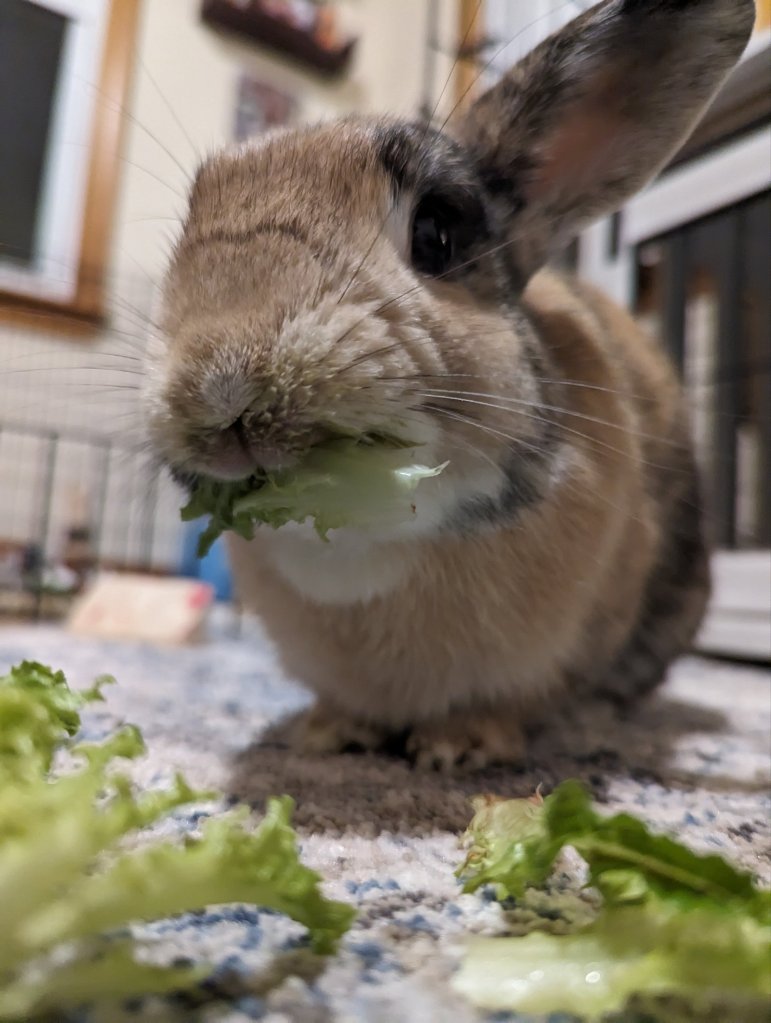
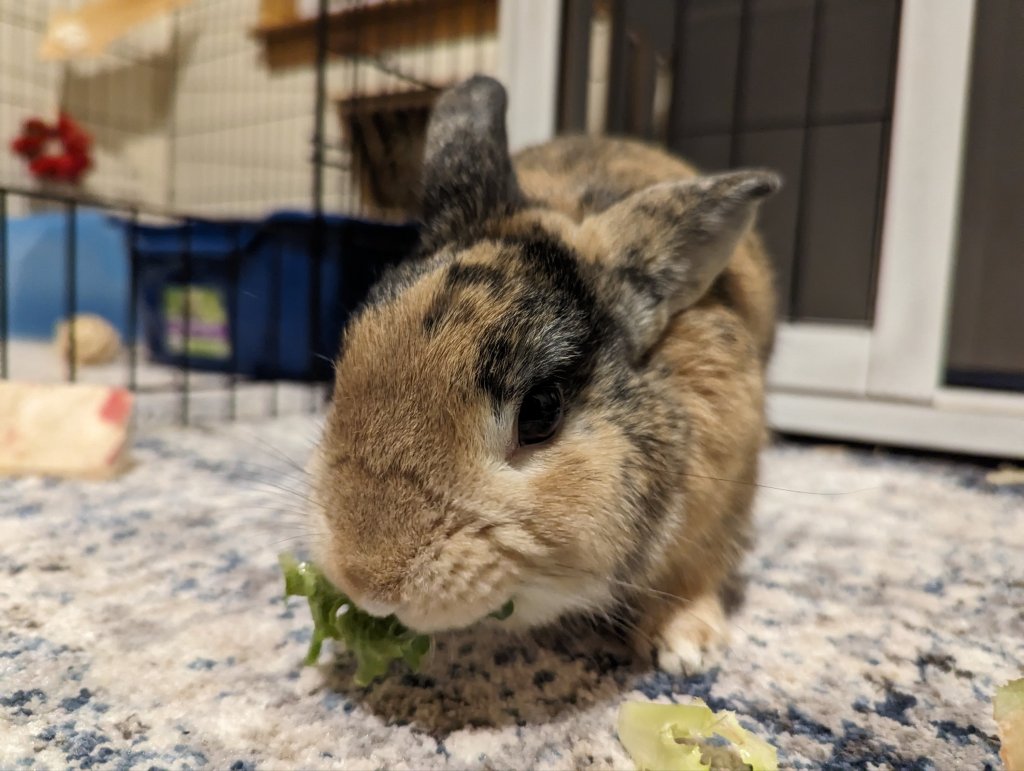
Hungry
Hamlet will grunt his needs
There’s a common stereotype with rabbits that they are very quiet and it’s very hard to tell what they want. They’re not like dogs, which have a wide vocal range of barks, whimpers, and whines.
But Hamlet pushes his communication skills to the limit.
You will know if you’re doing something “wrong.”
He has grunted:
When we were too slow opening the playpen so he could run around
When we reached out to pet him too fast (making him uncomfortable since bunnies have a blind spot right in front of their nose)
When we were too slow getting him his food (Why is your hand still there anyway? You need faster reflexes, obviously!)
It’s important to note that grunting in general is a communication technique, not necessarily an immediate indication of aggression. Hamlet has not bitten anyone! But we’ve also heeded his warning grunts. We’ve been respectful of his personal space and his (demanding) preferences.
Hamlet will claim your home
It took about a week for Hamlet to feel comfortable enough in the space to leave the playpen. We left the door open every night and sat nearby to supervise. But he only finally came out when he heard me unwrap a (very expired) lollipop for myself, not realizing that the crinkling was not me getting him a treat.
Once he was out though, boy was he out!
He immediately started running around investigating. After reviewing the area, he acted like he owned the place! He even came right up to me while I was sitting on the floor and bumped me with his nose, a “pet me now, please” signal.
Since then, he’s just been hoping right out and looking around every night.
Hamlet doesn’t know a treat he didn’t like
If you offer it to him, Hamlet’s eating it!
He loves all kinds of treats and hay, everything from rabbit biscuits to strawberry tops.
Don’t let him trick you into feeding multiple rounds of pellets! He’s definitely a bun that would fake starvation after just being fed.
Fast Facts about Hamlet
Here are some good things to know about Hamlet before considering adopting him:
Litterbox: He’s been trained to use the litterbox, and his habits are immaculate. Just know any bunny will accidentally kick out some poop as they’re jumping out of the litterbox.
Neutered: He has been neutered, so you don’t have to worry about the pricey surgery.
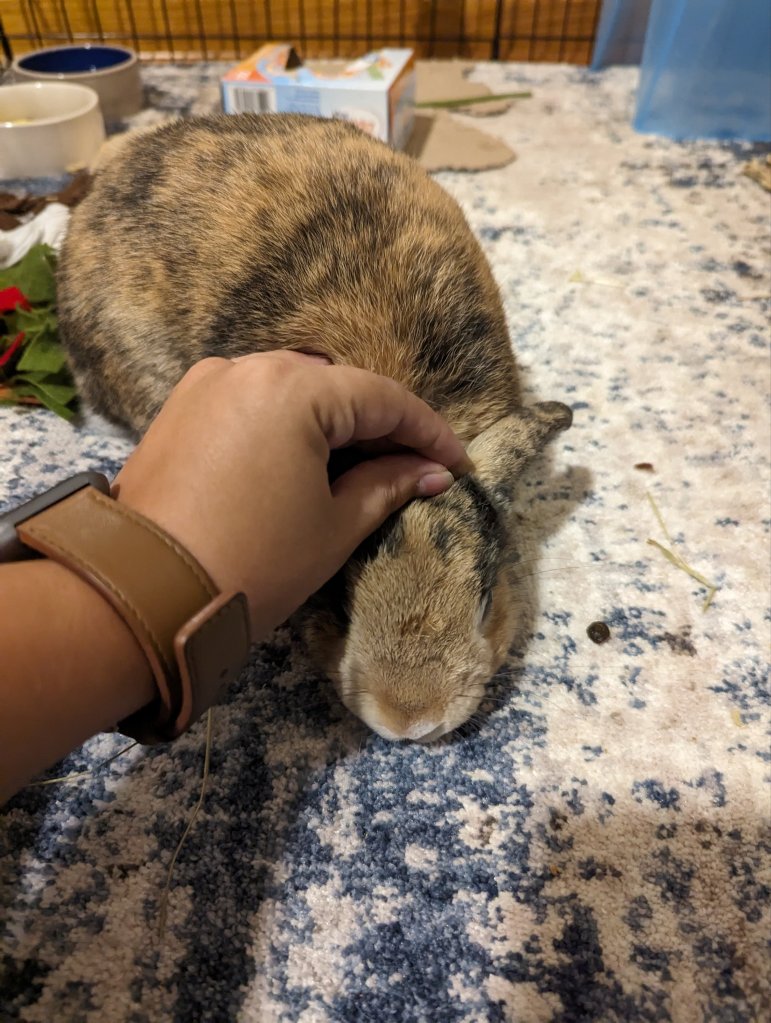
Petting Preference: Hamlet loves to be pet but likes pets to the head the best! And HE decides when you’re done petting him. If you stop too early, he’ll bump you with his nose and lower his head back into position for more! Hamlet is definitely one of those rabbits I can see asking you to pet him through an entire movie on the couch or something.
Update!
Thomas was adopted and bonded with another rabbit in his new home! A lovely happily ever after!
Stay Connected
Sign up for our newsletter through Substack. We’ll send updates about our latest blog posts and projects, so you won’t miss a thing!
It’s been a few weeks, and I think it’s high time we introduce you to our first foster rabbit!
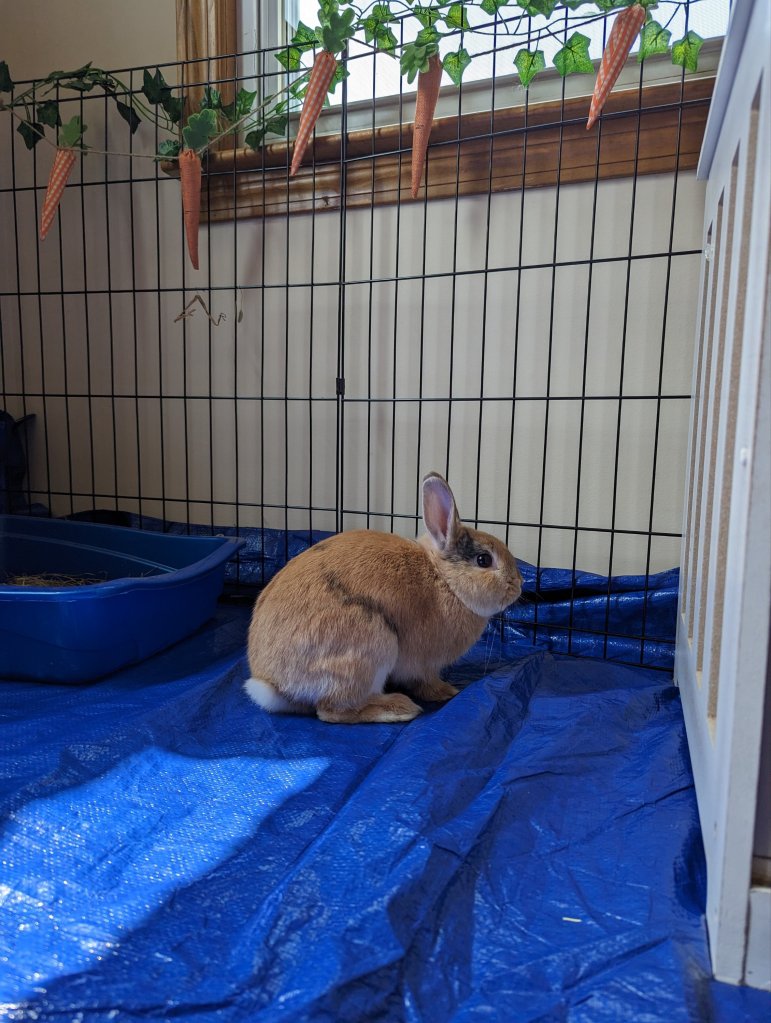
According to the House Rabbit Connection volunteers, Thomas was found abandoned in a park with his brother. They were housed side by side in x-pens until they were able to find separate foster families. Unfortunately, they can’t be reunited until they both have and heal from a neuter surgery.
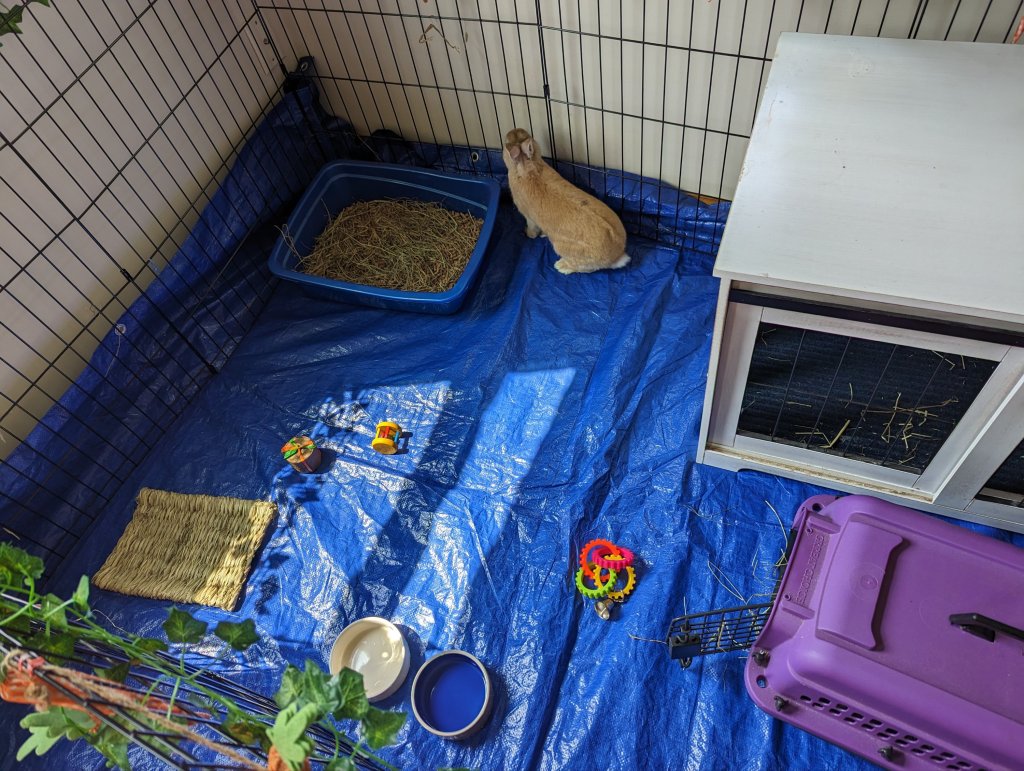
We made sure we had Thomas’s area all set up before we picked him up. When the time came, we made the drive and then plopped him in his new x-pen.
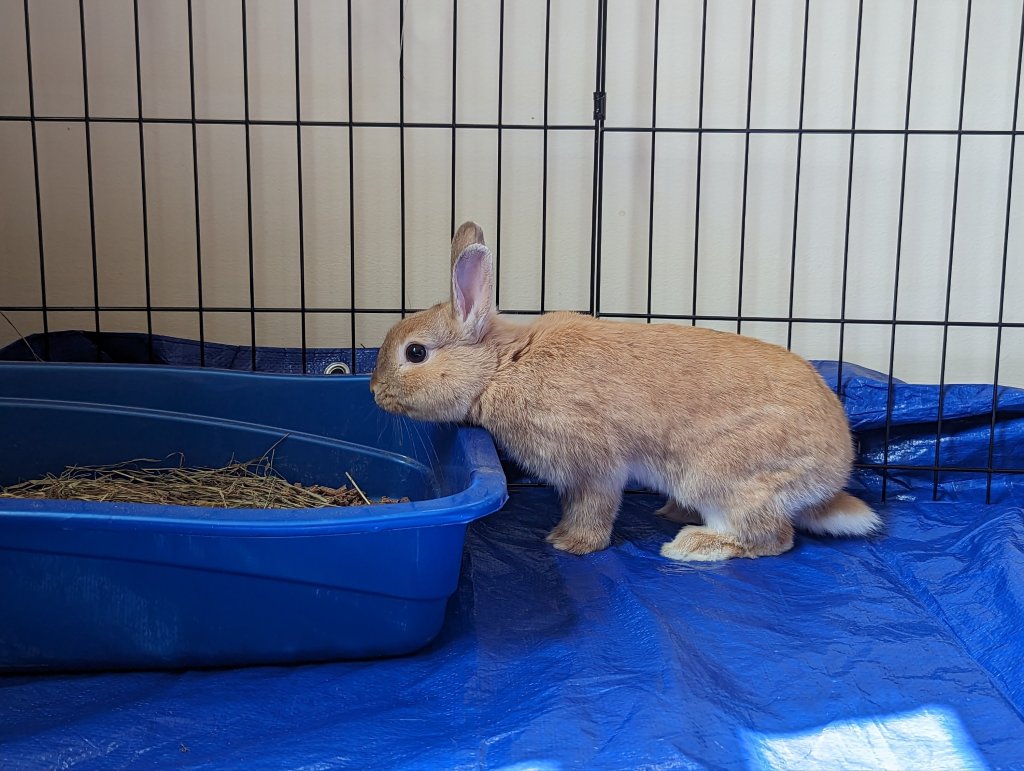
Since we weren’t sure of his litter box habits, we put down a tarp the House Rabbit Connection provided for us. Male rabbits who aren’t neutered can sometimes spray really strong smelling pee as part of their hormonal behaviors.
Thomas’ Eating Habits
Rabbits like routine, so we tried to maintain that same schedule of treats/feeding.
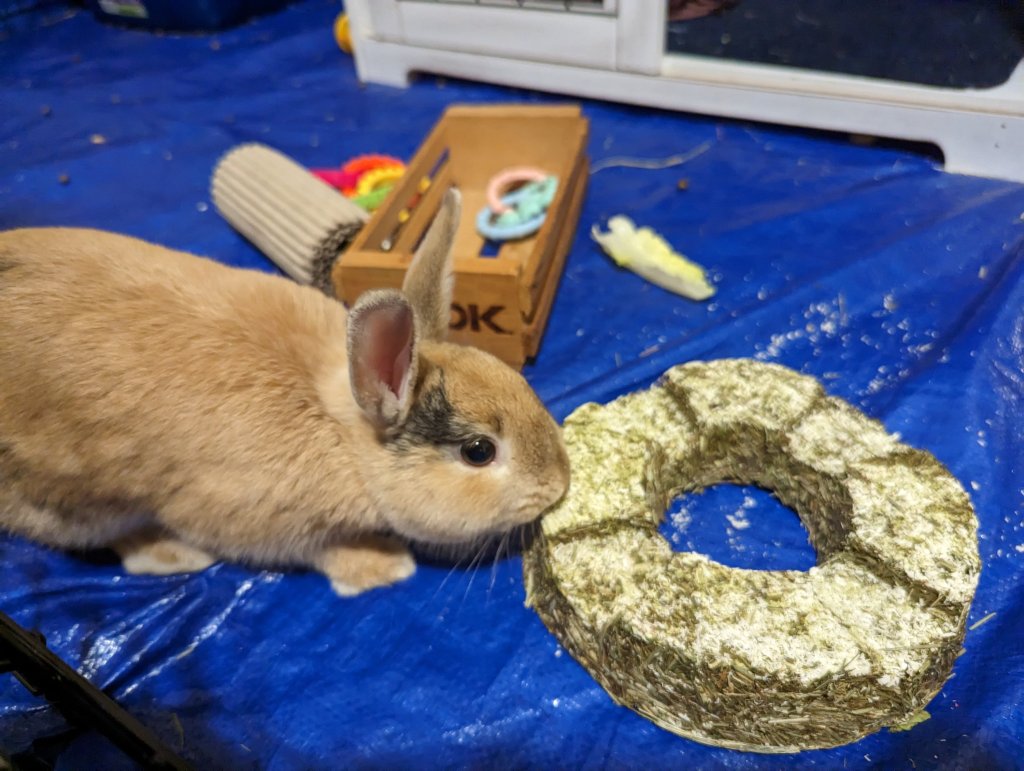
Thomas has proved very flexible with his food preferences. He seems to ALWAYS be hungry and goes through hay like nobody’s business.
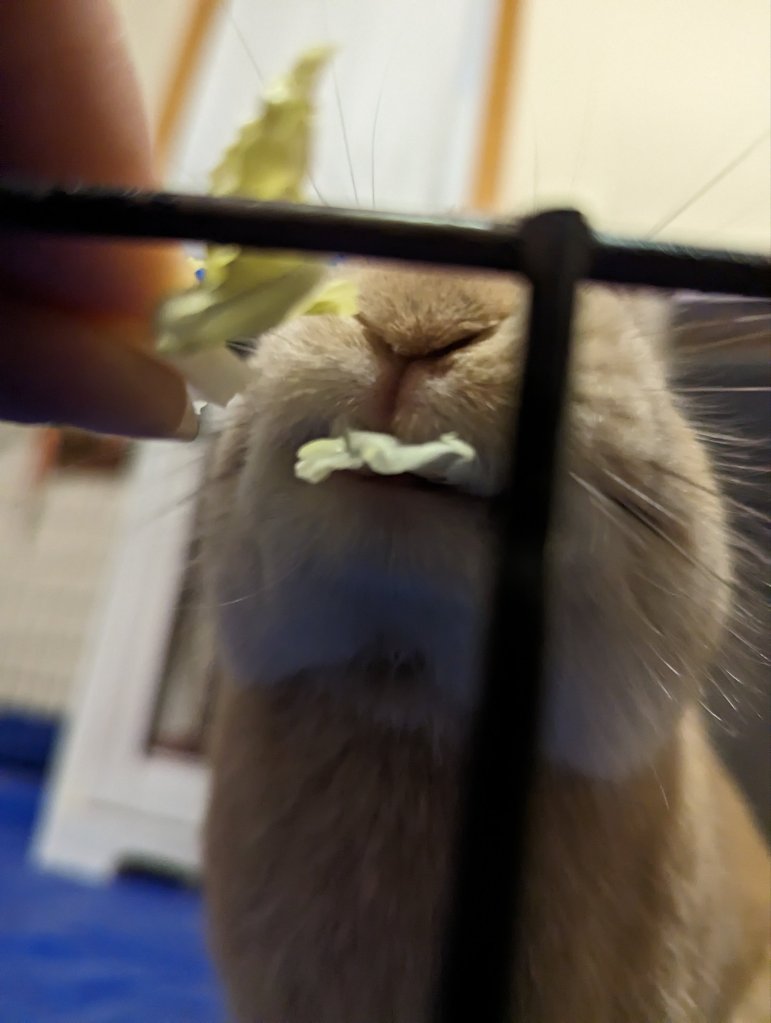
He gets lettuce, treats, hay, and fresh water every day.
Interactions with the Hoomans
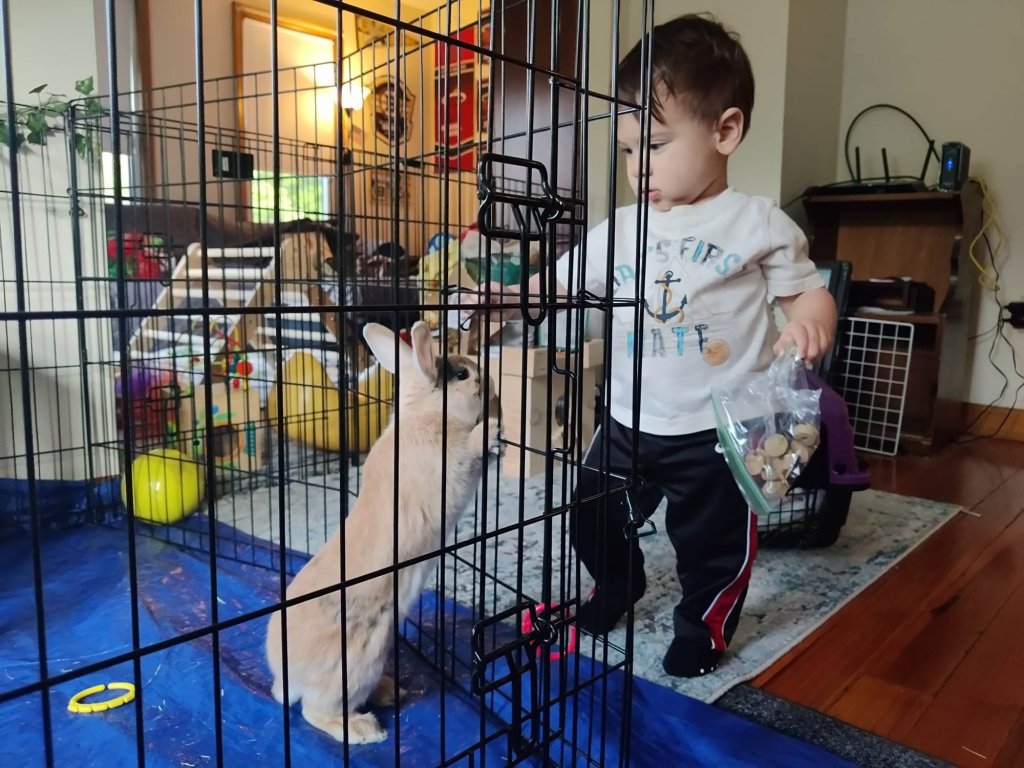
Our son loves to feed him his daily treat through the x-pen. Thomas runs up to greet him every time he comes over (and definitely not because our son likes to feed Thomas individual strands of hay every ten minutes).
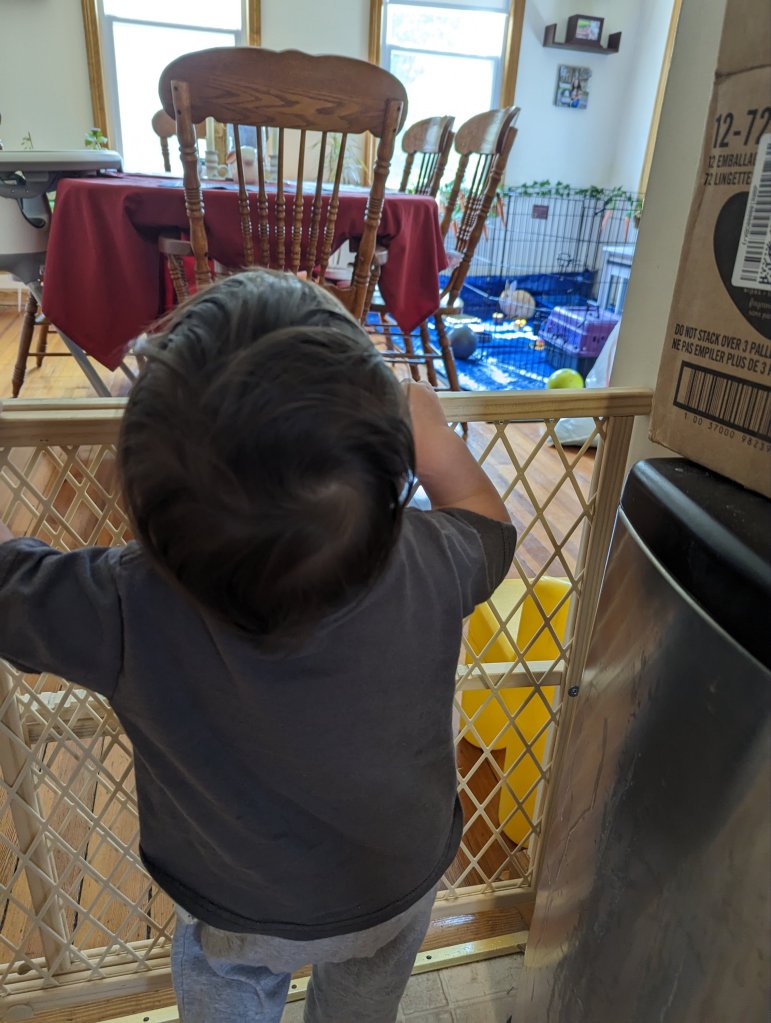
It’s important to note that we always supervise our son when he’s around Thomas. For one thing, we want to make sure their interactions are safe. For another, we know our son is a little too interested in the cocoa puffs Thomas produces from all that eating!
Thomas is a bit more tentative about petting.
My husband was the first one to really be able to get past Thomas’ skittishness. Turns out Thomas doesn’t love head pets like our past rabbits, but he’s alright with the occasional pet along his back.
A Great Family Bunny
This bunny doesn’t seem bothered by anything, really. Air conditioner noises don’t faze him, and he’s fine with toddler screeches.
In general, he seems very curious about the world around him – not a surprise since he’s a younger bunny.
Thomas has his quirks, which are fun to watch!
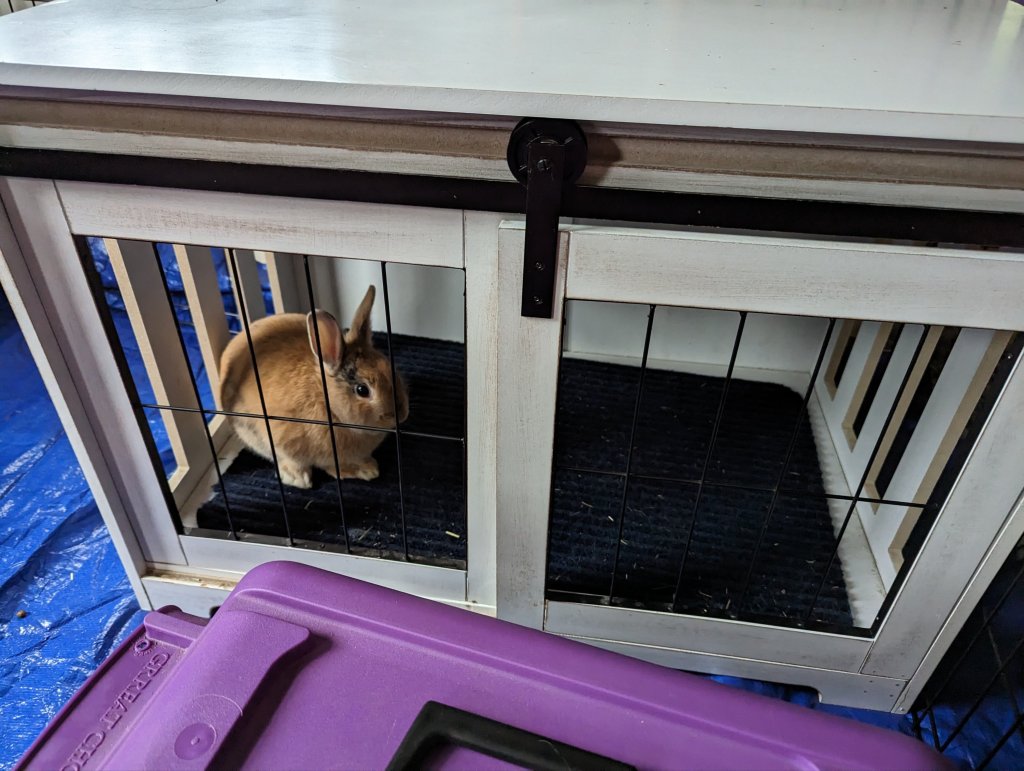
One night, we ran over when we heard a loud thump and couldn’t figure out what had happened. We figured it out the next day when we saw he had jumped onto a big pet hidey crate. He’s pretty loud leaping off of it when he’s had enough time looking over his dominion from higher ground.
We also figure out Thomas can squeeze into very tight spaces! When he first came to us, we had the sliding door to that hidey shut. We figured he’d want to get used to a smaller area in the new environment before expanding out.
Wrong!
We looked over and all of a sudden he was inside hanging out – with the door closed. The door’s been open ever since!
Adopt a Bunny From House Rabbit Connection
Thomas has a neuter appointment scheduled in Connecticut for the beginning of July.
After that, he’ll need some healing time before he’s either rebonded with his brother or adopted as a solo bun.
Until he’s adopted, we look forward to seeing Thomas bloom now that he’s off the mean streets!
Update!
Thomas has been neutered and will soon be up for adoption! He’ll be a solo bun, since his brother was “foster failed.”
Some things we’ve learned since he was neutered:
Thomas does not have a fear of hardwood floors! Some bunnies do, which can make rabbit proofing your home easier since they’ll stick to carpeted areas. Thomas is ready for adventures and exploring.
He does best when you ignore him while sitting within reach! The second you act like you don’t care whether he comes near you, he immediately has to investigate you and sniff around. Watch to make sure the book you’re reading isn’t nibbled!
He’s still getting used to new foods. While he’s good with romaine lettuce, parsley, grass hay, oat hay, and Timothy hay, Thomas is a bit suspicious of cut strawberry tops.
Thomas is a taste tester! He started chewing on the tarp we had down, so we had to replace it with a small area rug (which he’s so far left alone). He’s taken little nibbles out of wicket baskets. And watch out for cardboard toys. Rabbits can shred them, but ingesting can be dangerous to their digestive system (GI Stasis risk). Thomas unfortunately likes to eat cardboard.
Maybe a loved one got you a rabbit as a Christmas present. Maybe you got one for your birthday. Maybe you saw a rabbit at the pet store and couldn’t resist. Maybe you picked up a stray rabbit that was dumped by a previous owner.
While it’s not ideal, sometimes people end up with a bunny they didn’t expect would be in their lives.
Here’s a crash course on rabbit care if you find yourself in a situation like this.
Know the financial cost of owning a rabbit
Despite common belief, owning a rabbit is not cheap — if you’re doing it right, that is.
You may also want to consider getting pet insurance.
Know what to feed your rabbit
One of the most common mistakes new rabbit owners make is only feeding their rabbit pellets. It’s an easy mistake to make when even pet stores are giving out this false information.
Adult rabbits should primarily be eating timothy hay. If you’re allergic, you can always try oat or meadow hay instead.
You’ll also want to make sure you’re feeding your rabbit some veggies. And no, that doesn’t mean give them a giant carrot and call it a day. Cartoons like Bugs Bunny have been toting that narrative, but in reality, carrots are a bit too sugary to be their main course.
If you have a rabbit, please avoid keeping him/her in a cage 24/7. It’s like being quarantined in a small bedroom and never getting a chance to stretch your legs.
It’s even worse if you keep your rabbit outside in a hutch, exposed to the elements and potential predators. That’s very pre-2000’s rabbit care.
Ideally, your rabbit would be able to free roam. That means free reign of the entire house or certain rooms.
This isn’t possible for all pet owners. Some rabbits are extremely destructive. It may be for their own safety that they are only let out when they can be supervised.
In these cases, it’s great to have a playpen set up with additional flooring underneath, like an area rug. This way your rabbit can have lots of room to move around, and you can have peace of mind that they won’t eat anything dangerous.
Either way, you’ll have to make sure the areas your rabbit has access to are rabbit proofed.
Make sure to:
Hide all electrical cords or wires
Gate off areas that are not rabbit proofed
Cover baseboards if your bunny is a chewer
Move house plants out of reach (some are toxic to rabbits)
Rabbits DO NOT need baths. It can actually shock their body to experience that. If they have a “poopy bum,” you can give them a sponge bath on their butt with a damp cloth to loosen the mess.
Make sure get your rabbit’s nails clipped regularly. If they’re left too long, the nails can get caught on things and break. It can also make it very uncomfortable for your rabbit to walk. You can either learn to clip your rabbits nails yourself by watching YouTube videos or take your rabbit to a professional. Some vets will clip nails for a fee as well as some workers are pet supply stores.
Litter train your rabbit
Rabbits can be taught to use a litter box.
Make sure to get a large cat sized litter box and fill with either paper bedding or pine pellet bedding. Steer clear of pine shaving, since that can be bad for your rabbit’s lungs.
You can give your rabbit a hint at what you want by placing some dropping in the bin and putting hay there. Most rabbits like to snack and poop at the same time.
How to get to know your rabbit
This is the fun part of owning a rabbit.
Get to know your rabbit and their personality by spending some quality time together. Just sit down on the floor while your rabbit is running around. Eventually they’ll get curious and come to you.
It’s important to establish that trust and not force anything. Remember, rabbits are prey animals, so they likely won’t take kindly to being smothered by a stranger. It takes time to develop a bond.
In the beginning, try not to pick up your rabbit unless necessary for grooming, vet visits, or emergencies. Most rabbits prefer having all four feet on safe, solid ground.
There are many people out there who consider rabbits “starter pets.”
While this may make most bunny parents cringe, it’s understandable to think that if you haven’t researched the breakdown of how much it actually costs to own one.
Aside from love and care, rabbits need things – whether it’s food, shelter, or toys.
And they may need services like medical care or nail trimmings.
I’ll break down what some of the costs related to rabbits are.
Keep in mind, with a lot of these items, you may find bargains of Facebook Marketplace or you may splurge on pricier items. So this isn’t going to be an end all, be all number.
Consider this a guide if you’re thinking about getting a bunny.
More experienced rabbit owners may find this as a resource for pampering your pet or finding money saving opportunities.
Food
Rabbits need three categories of food:
Hay
Pellets
Veggies
Treats
Hay
Rabbits are supposed to eat a bundle of hay about the size of their body each day.
Hay helps wear down their teeth and keeps their digestive system on track.
The cheaper option
Technically, adult rabbits only need Timothy hay.
Local stores and farmers sell Timothy hay by the bale pretty cheaply.
I can usually get a giant bale of hay for less than $10, and that can last my Lionhead about 3-6 months depending on how hungry he is from month to month.
WARNING: If you go this route, just make sure your hay doesn’t come from a state with known cases of RV2. (SPELLING) This disease can be transferred through hay and is very deadly to rabbits.
The pricier options
Depending on where you live buying Timothy hay online or in a pet store may be your only choice.
This can get very expensive, but some people like the smaller shipments, especially if you don’t have space to store an entire bale.
Some bags of hay in the store or online can be around $8 for a small bag. I try to get these when they’re on sale for around $5.
I only buy these types of bags in Orchard Grass and Oat hay as a “treat” for Baby. Only using 2-3 handfuls a day makes each bag last about 1-2 months.
$20 (Timothy hay) + $60 (Special treat hay)= $80
My approximate hay total per year is $80.
Pellets
This one, I barely remember what I get. Usually I will just go to Walmart and get a giant bag for cheap.
Lately though, I’ve become more cautious about how many pellets I feed Baby each day. Pellets really discourage Baby from eating all the hay he needs to stay healthy. We even have to keep the tub we keep the pellets in hidden or else he will beg for them. At one point he had even tricked my husband and I into each giving him full portions of pellets each day (like a sneaky child).
The supply I have now will likely last a year, since he only gets a small handful from me each morning.
Some rabbits are very picky about which pellets they enjoy. Some rabbit owners only trust certain brands or don’t have the space to store bulk buys.
Some options I know of:
Manna Pro: About $10 for 25 lbs. (This is what I would usually get from Walmart)
I’ve also tried the smaller package of Manna Pro Rabbit Feed when I lived in a smaller apartment with less storage. It wasn’t bad, and Baby seemed to like it because the pellets were longer.
My approximate pellet total per year is $10.
Veggies
We typically restock on veggies every other week, and meal prep the food into glass containers. Each night, Baby asks for his veggie dish by standing near the fridge!
We try to give him a variety of greens and vegetables to keep him interested. But his favorite is definitely parsley!
$4.39 (Romaine Lettuce) + $1.29 (Parsley) + $3 (Carrots) + $2 (Celery)= $10.68 every other week
My approximate veggie total every other week is $10.68. Per year it is about $256.32.
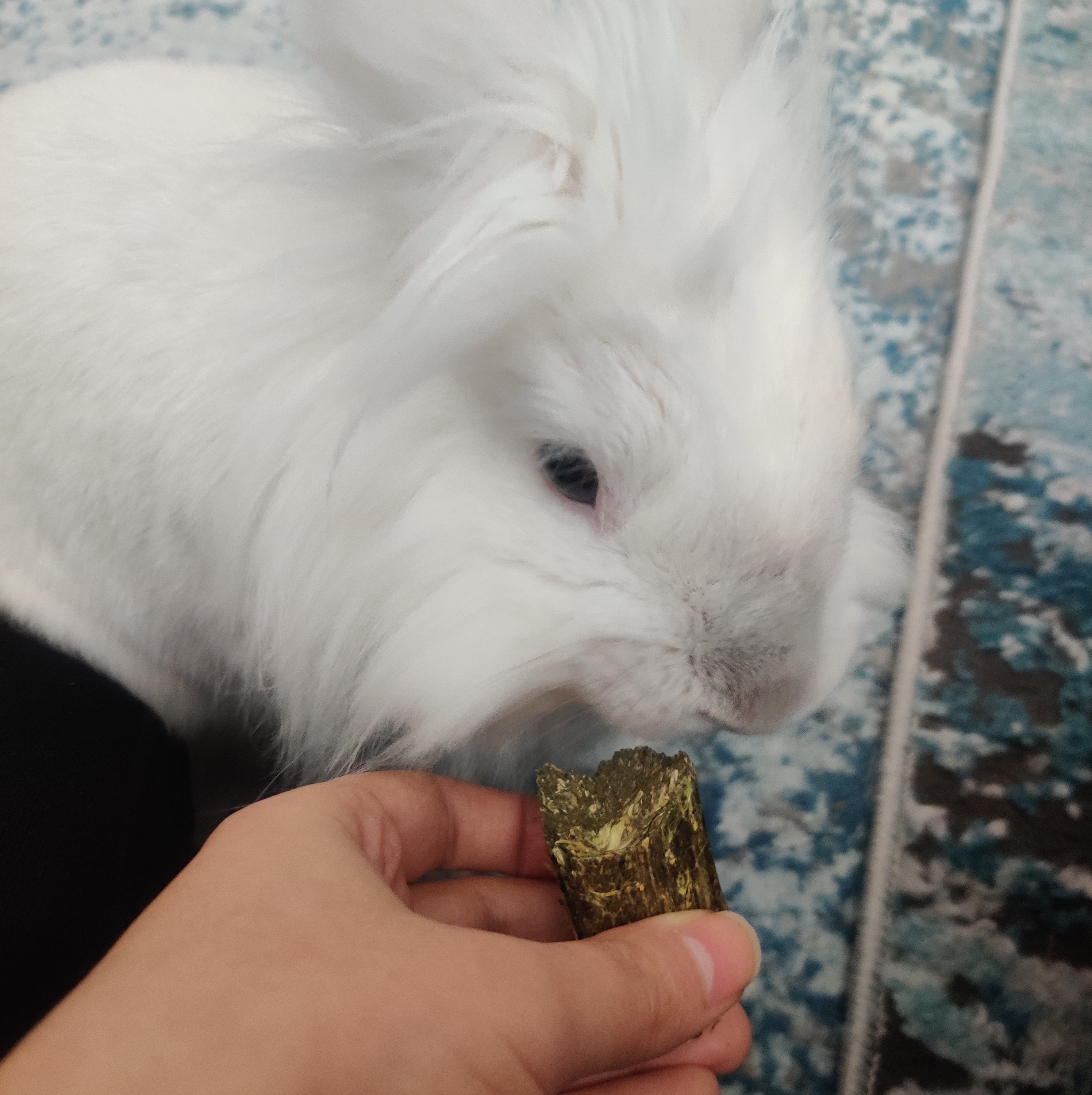
We discovered these timothy hay cubes when we were trying to get Baby to eat more hay. Because they come in a “treat bag” and can easily be carried off to a corner, Baby barely even notices it’s not an unhealthy treat – but just regular old compressed hay. The only downside to this is that when he really gets into eating it, the crumbling hay makes a mess. So more vacuuming is required. I’ve only bought one bag so far, but it’s lasted about three months. There’s still a lot more in the bag, so I’m thinking that’s two buys a year (about $5 each).
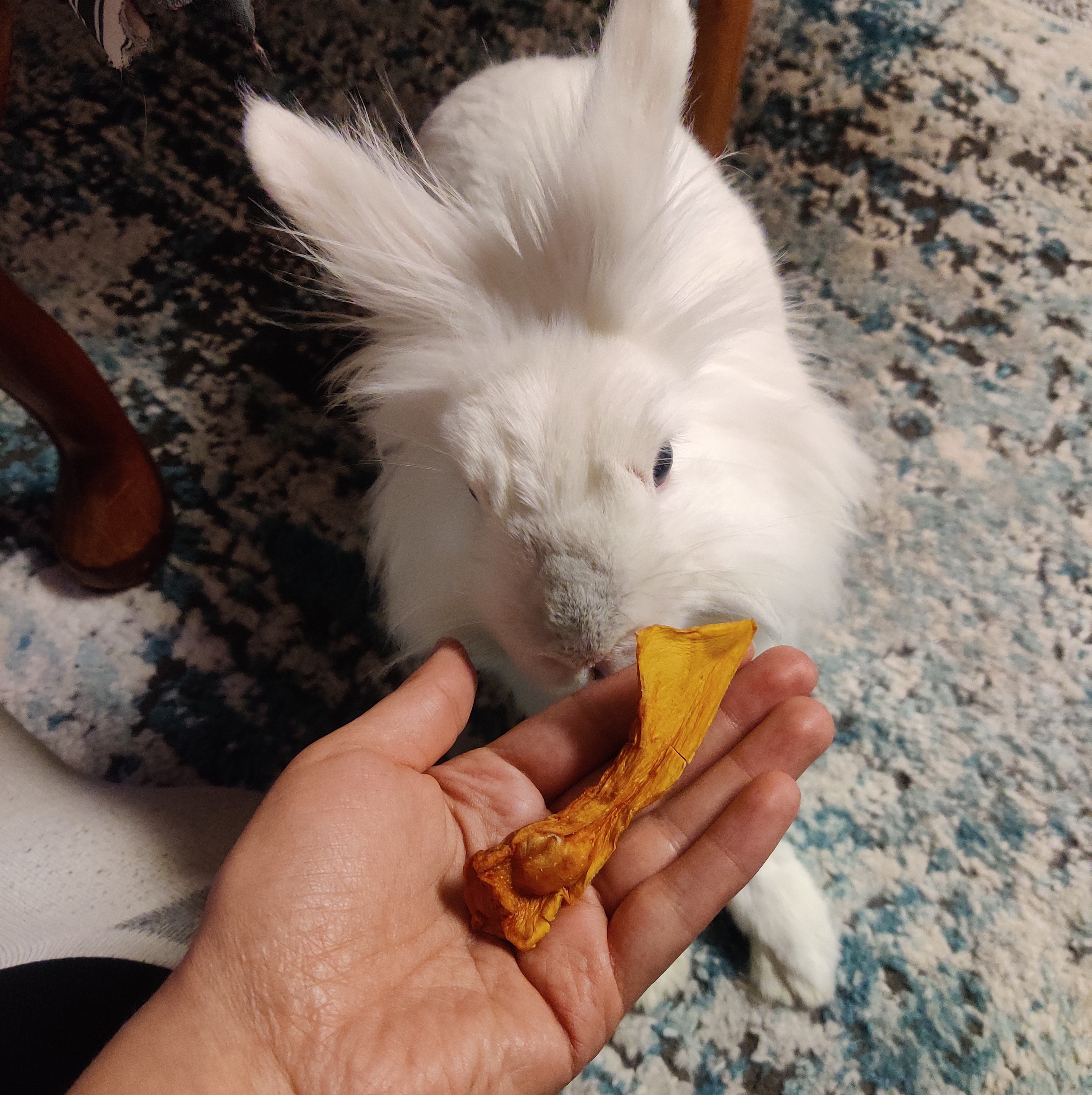
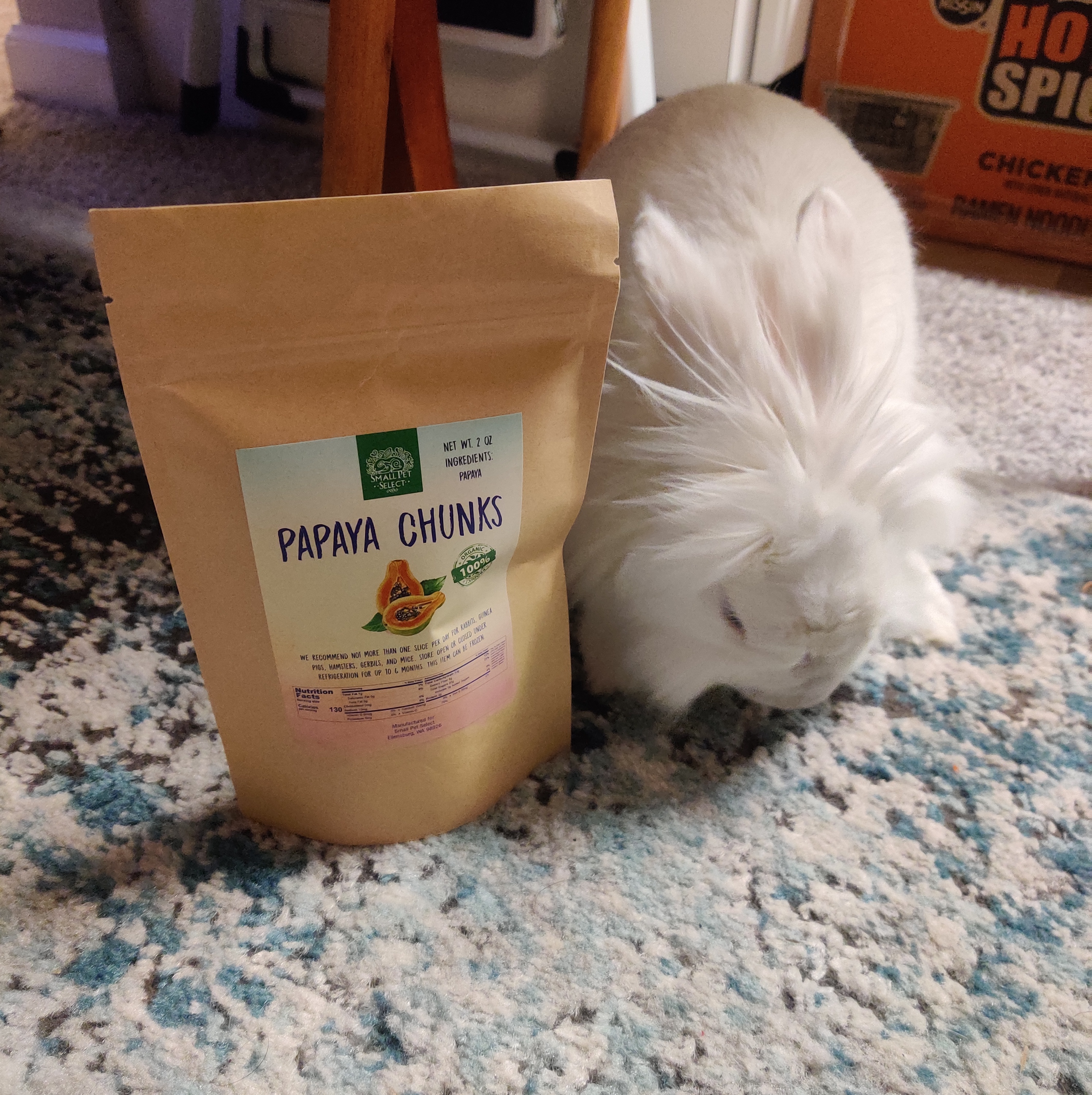
We also give Baby papaya treats. Our vet suggested it would help prevent GI Stasis by breaking down hair in Baby’s stomach. They come in long strips, but I cut them up into smaller pieces. He gets about a pinky nail size piece each day. I’m guessing each bag will last us about four months each, so I’m thinking we’ll end up buying 2-3 bags a year (at about $6 each).
$10 (Timothy Hay Cubes) + $18 (Papaya Treats)= $28
This is the category that you can either go really cheap or really fancy.
Look on Pinterest and you’ll see so many deluxe rabbit rooms with giant bunny castle setups and coordinating colors. There’s not really a limit to how bougie you can make your rabbit enclosure.
I’ll try my best to estimate what my current set-up costed, since I consider Baby’s area to be somewhere in the middle. It’s pretty simple, but does spoil him a bit.
I will not give a cheapo option, because I don’t support only caging bunnies with no free roam time.
What my setup costs
Things have changed over the years as I’ve learned what Baby likes and what he makes it his mission to eat versus enjoy. Some things have gotten their wear and been thrown out.
But here’s what’s in Baby’s pen now:
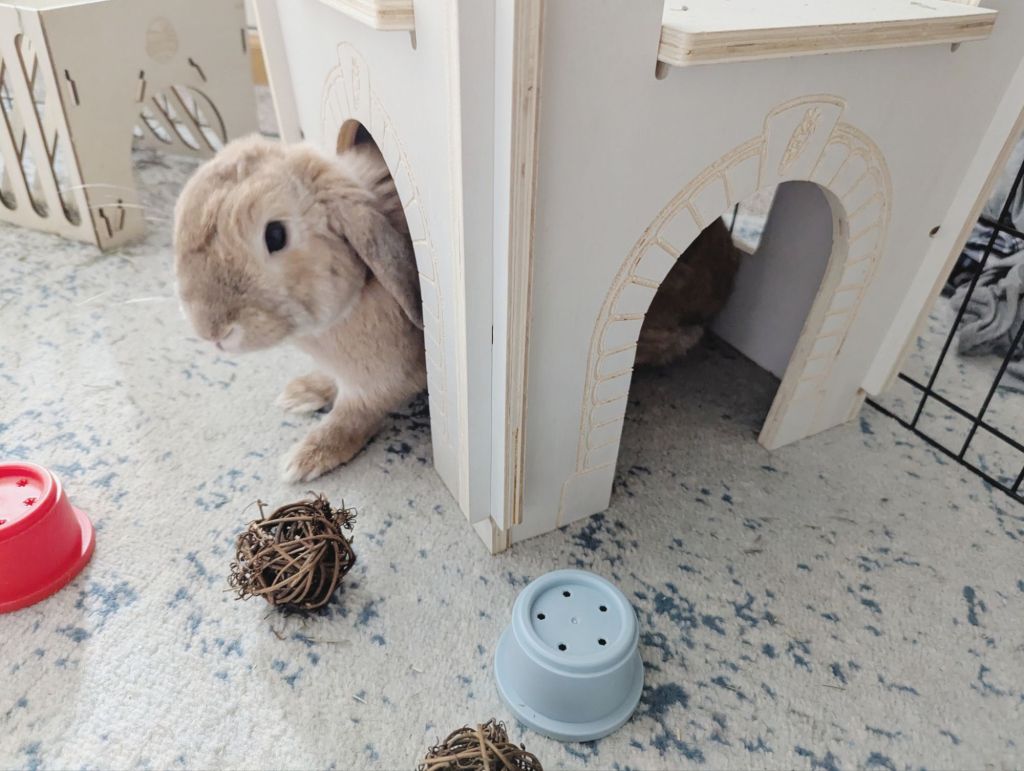
Rug: I keep a rug under Baby’s area in case he accidentally misses the litter box. I’ve also lived in apartments with only hardwood floors, which he treats like lava. I think I paid about $25 for it five years ago.
X-Pen: I got a pet playpen off of Amazon for about $45 (on sale). I’ve never had a problem with it. The pen is big enough for me to not feel bad leaving him in there overnight or when I’m not home.
Water Bowls: I don’t want to get into the whole bowl v. bottle debate, because we already looked at the research. Right now, we have a two bowls – one in his pen and one just in the living room for when he’s roaming. I don’t remember what I paid, but it couldn’t have been more than $5 each on sale.
Bed: Many rabbit owners have the famous Ikea bed, but I got the canopy bed at a tag sale for $5.
Litter boxes: Like the water bowls, we have two – one in the pen and one in the living room. One is just the bottom of a carrier that I got at a tag sale (likely also really cheap, but it’s great because the sides are so high). I got the other litter box at Walmart for under $10.
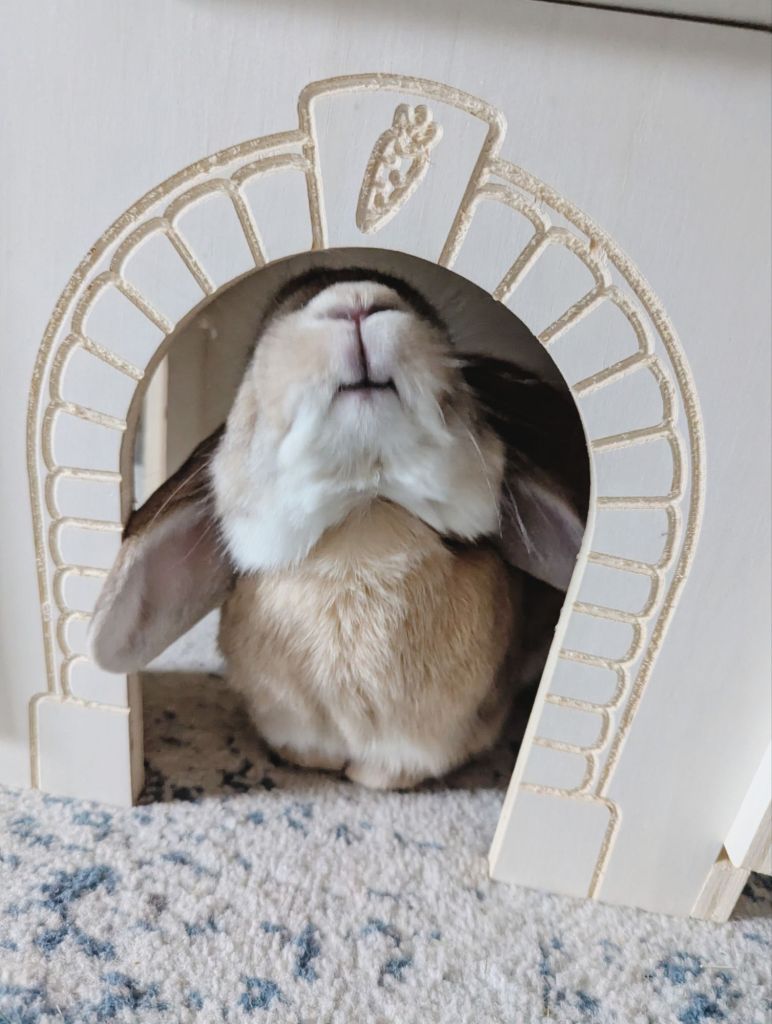
Castle: This was my one big splurge. Before, we had a secondhand cat condo for him to snuggle in (soooo cute). But then we realized he was secretly eating the cardboard lining inside. A bunny castle was the safest alternative we could think of, since the wood is safe for rabbits. Small Pet Select has since created a simpler version of their bunny castle, which seems more portable and better for apartments.
That’s the basics.
I also have random seasonal decor that I’ve bought from the Dollar Tree or random after-Easter sales on Michael’s and Jo-Ann Fabrics. I won’t include these in the total because these are more for my personal enjoyment. Baby definitely does not care about the ✨aesthetic✨ of his space.
Over five years, Baby has been through a lot. Here are some medical costs to consider:
Neuter
Yearly routine visits
Sprained leg
GI Stasis
This random time I looked on the internet and convinced myself he had a horrible disease when it was nothing.
I’d guess all of these things totaled up to about $10,000.
Luckily, I’ve always had an emergency savings account set aside for Baby and regular emergency money. So I was never unable to pay for care.
The sad things about medical care costs is that sometimes people are unable to spend thousands of dollars at a moment’s notice. From stories I’ve read on rabbit Facebook groups, some owners opt for health insurance through Nationwide while others have to stomach $15,000 in bills from ONE medical emergency. Some have even had to put their rabbits down or let them pass away at home because they could not afford care.
My approximate medical care total is $10,000.
One hospital trip left Baby with a shaved leg!
Extra spending
There are some things that are not necessarily necessities when it comes down to it. Depending on your circumstances and your knowledge of your rabbits preferences, you may not spend as much money on some of the following categories.
But you should definitely consider these things when considering just how expensive a rabbit can be.
Bunny Proofing: Each house/apartment requires something different, and each bunny’s destructive habits are different. For Baby, we’ve bought extra rugs as a precaution to protect the existing carpet. We’ve gotten free white cube stacking grids off of Facebook groups that we’ve used to block areas off. I’ve bought special tubing for cords that have to be in the open. This accumulates over the years and some things have had to be replaced or reinforced. I can guess I’ve spent around $200 over the years rabbit proofing various living spaces.
Toys: Technically a rabbit doesn’t need toys to live. But if you’re going to own a rabbit and not give it a SINGLE toy, you are a total monster. I’d say I’ve spent about another $150 on random toys (edible and plastic) since getting Baby.
Random Decorations and Photo Props: It’s difficult to guess what I’ve spent on decorations. Over several years, I’ve scoured tag sales, flea markets, clearance racks, and dollar stores. A random guess would be another $150?
Bunny Presents: Yes, I’m one of the rabbit owners who will buy her bunny Christmas presents and Gotcha Day presents. I’ve even made a bunny veggie “cake” and sang the Happy Birthday song to Baby. Over five years, I’d guess I’ve spent another $200 on these random things.
Failed Attempts: There have also been a bunch of things that Baby has not particularly enjoyed that I’ve “wasted” money on. If he doesn’t eat a whole treat OR I find out later it is unhealthy for him OR if he doesn’t even look at a new toy, it’s a fail for me. I’d say I’ve spent about $100 on random things that I’ve had to toss, donate, or resell.
Nail cutting and grooming: Some people pay for these services at local clinics or fundraisers. I just do them myself at home, so my cost is at least fixed. A HairBuster comb cost around $20, and nail clippers were probably a few dollars.
My approximate misc. spending total over five years is $823.
The approximate cost of owning Baby over five years is $12864.60.
That is an absolutely mind blowing number.
I have to remind myself that over five years, it’s easy to spend that much – especially since a lot of stimulus checks and tax returns went towards Baby’s care. And any other pet would likely cost something similar if not higher.
I love Baby, and if I had the money, I’d likely spend even more on him. In all honesty, I likely have spent more than that with random purchases I may have forgotten about. I’d give him the best bunny dream life I possibly could, with all the yummy treats and all the wooden tunnels and hidey-holes.
Every rabbit and rabbit parent is different. You may spend more money on your rabbit. You may spend less money on your rabbit.
Either way, it’s important for new owners to be aware that all pets cost money.
There’s no “I actually love my rabbit” spending threshold, but you should want to give your bunny a happy and safe life. Care goes beyond love and attention (which they also need).
Pet bunnies need owners who go into the process well researched and with the practical means to support them.
Stay Connected
Sign up for our newsletter through Substack. We’ll send updates about our latest blog posts and projects, so you won’t miss a thing!
Note: As an Amazon Associate I earn from qualifying purchases. I get commissions for purchases made through links in this post.
cuzrabbits gets commissions from some of the affiliate links in this post. Support our education efforts by buying your pet supplies at Small Pet Select.
Deciding whether or not to get a rabbit can be a pretty tough decision. There are a lot of different factors to consider. A rabbit is certainly not for everyone, but they make adorable additions to the family.
These lists are not even.
Being a bunny lover, I’m pretty partial to the pros. But the cons can be real deal breakers for people. Know yourself and what is important to you in a pet.
Pros
Having a rabbit in your family means having an instant cuddle buddy all the time!
Adorableness: Rabbits are sooooooo cute. They’re perfectly Instagramable eye candy!
The rewarding connection: There’s just something about earning a rabbit’s trust that is simply magical. Rabbits are naturally prey animals, so they don’t just cozy up to anyone. So when you’re petting your rabbit, and she starts licking you, it feels like you’re The Chosen One.
The perfect bingeing pal: Rabbits are indoor pets, so they’re happy to stay inside with you all winterlong. For Baby and I, it meant binge watching the entire Gilmore Girls series on Netflix. Just a girl and her bun hanging out together ❤
Litter training: Similar to a cat, rabbit can be trained to use a litter box. It means you don’t have to let them out to do their business when it’s raining or when there’s a snowstorm. Some pet parents recommend changing the litter box once a day with shedding top offs, while others settle for every couple of days. It’s as clean as YOU keep it. So if it starts to smell, whose fault is it, really?
Teaching tricks: Rabbits can learn to do tricks. The best example I’ve seen is Bini the Bunny, but you can teach small tricks too. Baby and Pepper can both come when called. In the past, I’ve taught rabbits to stand up on their hind legs on command.
Being trained: Your rabbits often train you! Baby once tricked my mom into petting him for two hours straight by giving little nudges and encouraging nips when she stopped petting him. He has also trained me to give him a carrot every day as soon as he hears me wake up.
Independence: Rabbits are the best combination of dogs and cats; oftentimes playful like a puppy but can do their own thing like a cat. You can go on a day trip and not have to worry about accidents at home. You don’t have to race home to let them go to the bathroom. You can go on a weekend trip if you stock rabbits with the essentials. Although bunnies love a good cuddle, they don’t need your attention 24/7. It offers flexibility.
Long life: Bunnies are not like goldfish you buy at a carnival. Without illness, an indoor rabbit can live to be around 10 to 15 years old. You’ll have time to really bond with the bunny and have a long time partner in crime.
Bunny habitat: It is so much fun figuring out a setup for your bun! Even if you free roam your rabbit, you can make cardboard castles, box tunnels, etc. Or you can go fancy and convert a dresser into a bunny bungalow. See Pinterest for inspiration!
The bunny community: You’ll be able to join other pet parents online, sharing cute pictures and getting advice. There are Facebook groups and plenty of bunny Instagram accounts (like ours!)
Cons
Rabbits are destructive, so you have to give them plenty of toys and activities to keep them occupied.
Not a dog/ long bonding times: While some rabbits will follow you around and go for walks on leashes, they are NOT dogs. They won’t give the same burst of affection that dogs will. Bunnies are subtle creatures. You have to really make an effort to learn their language and bond with them. Once you do, you’re golden! This long-term bonding strategy is not for everyone.
Lots of attention: While rabbits enjoy their independence, they do need a lot of love. That’s petting, cuddling, and just generally hanging out together. It is really, really nice, but you have to set aside the time for the pet you dedicated yourself to.
Extensive care: A lot goes into making a bunny life buntastic! Bunnies need their nails trimmed, plenty of fresh hay and water, and toys. They’re work, just like literally any other pet.
Expenses: It’s important to consider the cost of owning a rabbit – and not just the actual adoption fee. Over time, rabbits can become very expensive. Medical emergencies can come up, you may have to buy a bunch of toys before finding one your bunny actually likes, and food isn’t always cheap. Make sure you know what you’re getting into!
Lots of Shedding: Like every pet that is not a naked mole rat, rabbits shed hair. It falls off in varying amounts depending on the season. They need to be pet/ groomed every day (but some breeds may require extensive brushing) to get rid of the loose hair. If you don’t, all that hair can stay in their stomachs. Rabbits can’t throw up hairballs like cats, so it can cause health issues. Basically, lint rollers will become your best friend.
Bunny-proofing everything: Each rabbit is different, but each have a bit of a destroy-your-house instinct. They’re like little kids who know they’re doing something wrong but still do it. Some bunnies will chew your cord and phone chargers. Some will bite at your wood baseboards. Some will rip up your carpet. Some will eat the buttons on your TV remote. The list goes on and on and on and on and on. As a pet parent, you will have to monitor your bunny’s behavior and make necessary changes. This takes time and work. Full warning: no matter what you do, something will be destroyed eventually.
Weirdness: You’ll end up being that weird person with a rabbit. Many people will say things like, “Why don’t you just get a dog?” or worse, “Lol rabbit tastes good.” I’ve heard and read the nastiest and most insensitive things. You’re going to have to find a way to deal with that, either by ignoring it or venting to the rabbit community.
Did I miss any pros or cons? Let me know in the comments!
Stay Connected
Sign up for our newsletter through Substack. We’ll send updates about our latest blog posts and projects, so you won’t miss a thing!


































 cuzrabbits