Is Nationwide Pet Insurance worth it for your rabbit?

Bunnies are oftentimes branded as “easy starter” pets. So it’s no surprise that many pet parents are blindsided by just how expensive the vet bills are for rabbits.

Depending on the level of care your bunny needs and the vet prices in your area, some emergency visits can run you thousands of dollars into debt. And hopefully your rabbit doesn’t end up with a chronic condition that needs treatment every few months!

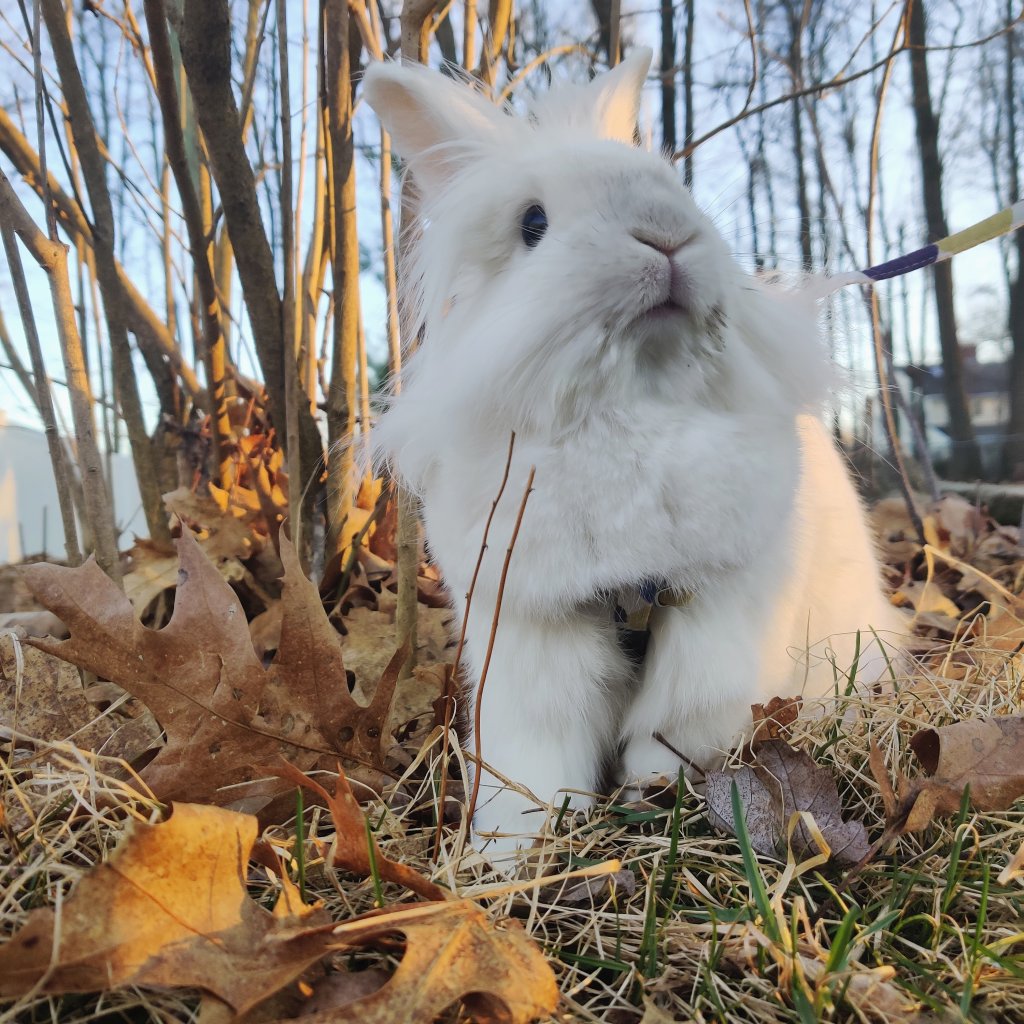
Baby (my lionhead son) and I have gone through a pet healthcare rollercoaster, and we’d like to offer our two cents on the topic.

What companies offer pet insurance for rabbits?

In the United States, Nationwide is the only company that offers pet insurance for rabbits.

That being said, it doesn’t work like human health insurance. If your vet bill is $1000, you have to pay the full amount up front to your veterinarian. You’ll be able to file a claim with Nationwide and potentially get reimbursed afterwards.

Should you get pet insurance for your rabbit?

This is a really tough and personal question.

My abridged version is this: Get pet insurance as early as possible – as soon as you get your bunny even. Pre-existing conditions are deadly to your wallet, so it’s best to get your bunny in while they have as few ailments as possible.

I used to think pet insurance wasn’t worth it

Before I had Baby, my family never had pet insurance for any of our past rabbits. My parents paid for checkups when needed and paid for care when ailments came up. Seemed easy enough!

So when I got Baby, my lionhead rabbit, I didn’t really think I needed pet insurance. It seemed like the monthly premium would be much more expensive than just paying for an annual checkup. I also added $100 or so each month to an emergency fund dedicated to Baby. After a few years of healthy rabbit living, I’d amassed a few thousand dollars.

Why would I ever want to pay extra money each month for a service Baby wasn’t even using? The ailments he did have (a slightly hurt leg, my delusions from looking at the internet and thinking he had megacolon) could all be covered with my stash.
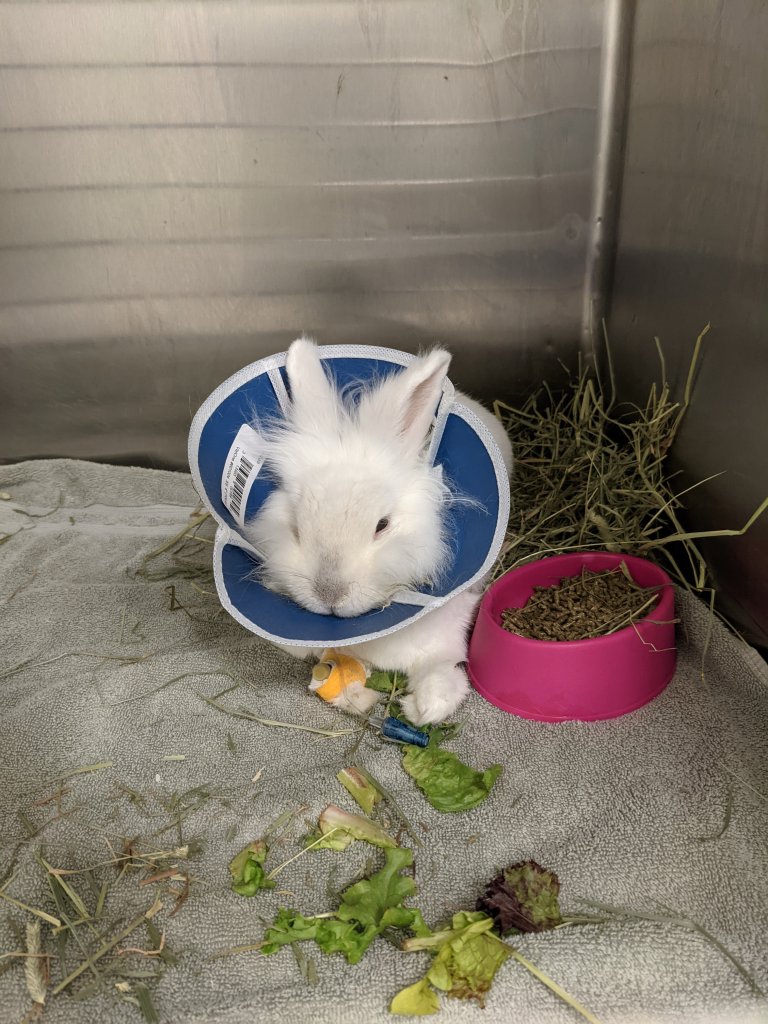
The health crisis that changed my mind

Everything changed after Baby’s 6th-ish birthday. He had three instances of GI stasis within less than a year. Each visit ended up being around $2,500 in emergency vet bills.

After the first instance, I ramped up my savings to try to replenish the emergency fund, but there just wasn’t enough time. I ended up using all my stimulus money and my tax refund to help pay for all these medical bills. On top of that, when I did get sign up for pet insurance, GI stasis wouldn’t be covered.

I definitely regret not getting pet insurance sooner. It would have saved me so much money, and I wouldn’t have had to worry about how to pay for care.

On the bright side, now that I do have pet insurance, some of Baby’s new medical needs are taken care of. He recently needed dental work. Once I met the deductible, the rest was covered. When he has to go back for a three-month follow-up appointment, I don’t have to be as stressed about the money aspect of it, just his health.

What should you do?

There are some things to consider when deciding whether to get pet insurance:

  • How old is your bunny?
  • What illnesses does your rabbit already have?
  • Does you rabbit need to be spayed/neutered?
  • What can you afford?

Each rabbit is different. Some of my rabbits have lived long, happy lives with barely any health issues. One in particular seemed to have everything from head tilt to picky eater bouts. The problem is, you can’t necessarily tell in advance which one your rabbit is going to be.

Your bunny could cost you hundreds of dollars OR tens of thousands. Your savings could cover expenses OR you could have to decide between your rabbit’s health and crippling credit card debt.

In the end, you have to decide what is right for your family financially.

Example of a bunny insurance plan

The pet protection plan that Baby has covers accidents, illnesses, and hereditary conditions. I’m reimbursed 90% once the $250 annual deductible is hit.

Make sure to talk to an agent before deciding whether or not to get pet insurance. You may get a different rate depending on where you live and how many rabbits you’re covering. Your workplace may also have a deal that will allow you to get a discounted rate as part of your benefits.

You can also get a quote from Nationwide by filling out an online form.

What is NOT covered by insurance

It’s important to note that it’s 90% of eligible expenses.

Nationwide will not cover:

  • Medical waste
  • Tax
  • Over the counter “accessories”
  • Record or copying fees

A claim can be partially or completely denied because of these things.

Let’s say you had a bill that cost $100 and medical waste was $10 of that. Assuming you’ve reached your $250 deductible, Nationwide would reimburse 90% of the remaining $90.

Pre-existing Conditions are NOT covered

If you get nothing else from this article, understand that pre-existing conditions, any illness or condition your bunny has before you get health insurance, will not be covered. So if your bunny has a history of GI stasis, like Baby does, any veterinarian visits related to GI stasis will not be covered.

What does that mean for you?

If you plan on getting insurance, get it as soon as you get your bunny! DO NOT wait until your rabbit gets sick to get pet insurance. Otherwise, you’ll find yourself paying monthly for something you won’t even be able to use.

Know the details of your own plan

Each plan is different, so make sure you know what’s covered and what is not with your specific bunny.

When you first call Nationwide to get insurance, the agent will ask you a bunch about your rabbit. This is where they’d learn about pre-existing conditions, although I’m pretty sure they’ll contact any veterinary offices or hospitals you list to verify the information.

Make sure to ask as many questions and hypotheticals as you need to understand your new policy.

Make the right decision for your family

The topic of pet insurance is often a divisive issue in social media groups.

Some are convinced it is a scam. It’s frustrating to pay so much money especially if your bunny already has a bunch of pricey pre-existing conditions. Others have found the service a literal lifesaver!

I regret my decision not to get pet insurance from the beginning, but you live and you learn!

Be sure to make an informed decision for your own bunny family.

Share your story

It’s important that we learn from each other as a rabbit community!

Share your pet insurance experience in the comments below or let me know any questions you may have!

Stay Connected

Sign up for our newsletter through Substack. We’ll send updates about our latest blog posts and projects, so you won’t miss a thing!

How to convince a landlord to let you have a rabbit

As bunny owners, our furry friends are true members of the family! But in some areas, it can be difficult to find pet-friendly apartments.

The last thing anyone wants to do is give up their pet because of a difficult housing search. There are some things to look for when trying to find housing that will work for you and your fur child.

4/5 of the apartments I’ve had over the last six years have not been officially “pet-friendly.”

Here’s what worked for Baby (my lionhead fur child) and I!

What to look for in an apartment listing

If you don’t see a lot of listings for pet-friendly apartments in general, try narrowing the search to “cats allowed.” A landlord is typically more likely to allow cats than dogs. Plus it’s easier to get your prospective landlord to compare a rabbit to a cat (both can be litter trained, both are relatively quiet, etc).

But don’t necessarily let “no pets” warnings within the listings deter you from asking about a rabbit. Oftentimes landlords automatically think of pets as cats and dogs, so they might consider a smaller pet.

When I owned an aquatic frog as well as a rabbit, I literally asked my prospective landlord, “I know the listing said no pets, but would you allow a little bunny and a frog?” He ended up laughing and saying he’d definitely allow such small pets.

Sometimes it just comes down to how you frame your question.

How to convince your landlord to allow bunnies

In my experience, it all comes down to framing.

Many landlords seem to have the antiquated perception of rabbits as pets. They picture your bunny in a tiny little cage, more like a hamster.

While it’s important not to lie, I typically don’t specifically say I’ll be free roaming my rabbit. I just play up the cuteness of bunnies and how little they are. Doing this seems to minimize the impact of rabbits on the wellbeing of the building itself in the landlord’s eyes. Like how could my little bunny rabbit possibly be any trouble?

It also helps, of course, if you’re a stellar tenant with a great track record. Make sure to fill out applications properly. Chat with the potential landlord to create a positive repertoire. And hopefully you haven’t let your rabbit destroy past apartments so you can have good references to vouch for you!

What to say to your potential landlord about your bunny

Here are some things I’ve said to landlords:

  • “I know the listing says ‘No Pets,’ but do you allow smaller animals like fish or rabbits?” – I find putting rabbits in the “Fish” category makes them seem less problematic.
  • “I have a white rabbit. Is that alright?” – This is typically followed by showing the landlord a bunch of cute photos of Baby, my rabbit. It can be hard to resist his lionhead allure!

Decide whether to free roam or not

In an ideal world, all pet bunnies would be able to free roam all day long. But for many renters, that may not be an option.

Know your rabbit.

Some rabbits can free roam all the time and be perfect angels. Others will start riping up carpet the second you turn around.

If your bunny is destructive, I’d recommend a hybrid approach.

While living in our first apartment, I started out Baby free roaming full time once he was litter trained. Then, a few months in, I discovered he’d been secretly ripping up the rug in one corner of the living room. Not only was this a danger to my deposit, it was very dangerous for Baby’s digestive system. From then on, we’ve let him free roam while we can supervise, but put him in a large playpen at night and when we have to leave the apartment.

Tips for bunny-proofing your apartment

If you do decide to free roam in any capacity, you’ll want to take a mental analysis of your apartment.

Even if you bunny-proof to the extreme, you should routinely check around to make sure your bunny hasn’t gotten past your defenses. There have been many times where Baby has masterminded his way around some of our tactics. We compare him to a velociraptor from Jurassic Park sometimes!

What kind of flooring does your apartment have?

If your bunny is the type that’s afraid of hardwood, you might need to buy some area rugs. If your apartment is carpeted, you may have to put down some tiles (you can buy by the square at a hardware store) or buy rugs to out on top of rugs.

We did the double rug route for underneath Baby’s playpen since he’d be there even when we couldn’t supervise.

Does your apartment have baseboards?

Some rabbits love to chew on the wood.

You can block off baseboards with wire cube storage squares. We’ve also used these to block off the bottoms of tv consoles and some areas with wires.

Where are the cords in your apartment?

This is especially important if you have a long cable/internet cord. In some apartments I’ve had, these cords have been VERY long.

You can either block off the area with wire cube storage squares or put a wire protector over it.

Respecting a landlord’s decision and avoiding disaster

At the end of the day, it’s your landlord’s choice whether to allow pets or not.

The one thing I would never do is secretly keep a pet in an apartment that does not allow them.

One of my landlords let me have a rabbit in a no-pets apartment when I asked in advance. But he told me a story of a former tenant who had secretly gotten a dog. When another tenant complained about the barking, he had to tell her to either move out or give up the dog. She ended up giving away the dog. Such a sad story and so avoidable! And the landlord is a really nice guy who felt awful about the whole thing.

Lying to a landlord and breaking a contract could result in heartbreak or, even worse, legal trouble! Don’t put you or your rabbit in that kind of situation. It’s worth putting in the extra work to find an apartment that really does allow pets or even moving to another town to find more options.

Finding alternatives

Unfortunately, things don’t always go the way we plan.

Maybe there are barely any apartments in your area for rent. Maybe you’re priced out of all the apartments that allow pets. Maybe there’s just too much of a time crunch to find anything.

Whatever happens, it’s important to do what is best for your bun — whatever that means to you.

I’ve seen stories on rabbit Facebook groups of people who have lived out of their cars with their rabbits so they could keep their families together. Others have given their rabbit to friends or family on a temporary basis.

If you do have to give your rabbit up permanently, make sure you do so safely.

Do not give your rabbit up for free or even for a small fee on Craigslist or Facebook. Some people use those platforms to find easy food for snakes. It’s much better to find a local shelter or home-based rescue. These groups tend to care very deeply for animals and have the resources to connect your bunny with a new home.

Pray for the best!

Hopefully you’re able to find some awesome, pet-friendly housing for your family.

Don’t underestimate the power of prayer. During your search, you may want to call upon St. Melangell, patron saint of hares, for help!

Happy house hunting!

Note: As an Amazon Associate I earn from qualifying purchases. I get commissions for purchases made through links in this post.

Never miss an article!

Processing…
Success! You're on the list.

How to celebrate your rabbit’s birthday and gotcha day

In our household, we love to celebrate!

We give our lionhead, Baby, a photoshoot for almost every holiday – and his gotcha day is no exception!

But a gotcha day is about more than some pics! We go all out! It helps that my birthday is the same day as Baby’s gotcha day!

Here’s how we roll! Hopefully it gives you some ideas for your own celebrations.

Make a veggie cake

Pamper your bun with a veggie cake!

There are some small businesses who sell bunny friendly cakes. They typically don’t use fresh veggies. Instead they’ll use compacted baked treats. The creations look amazing!

You can also make your own pretty easily.

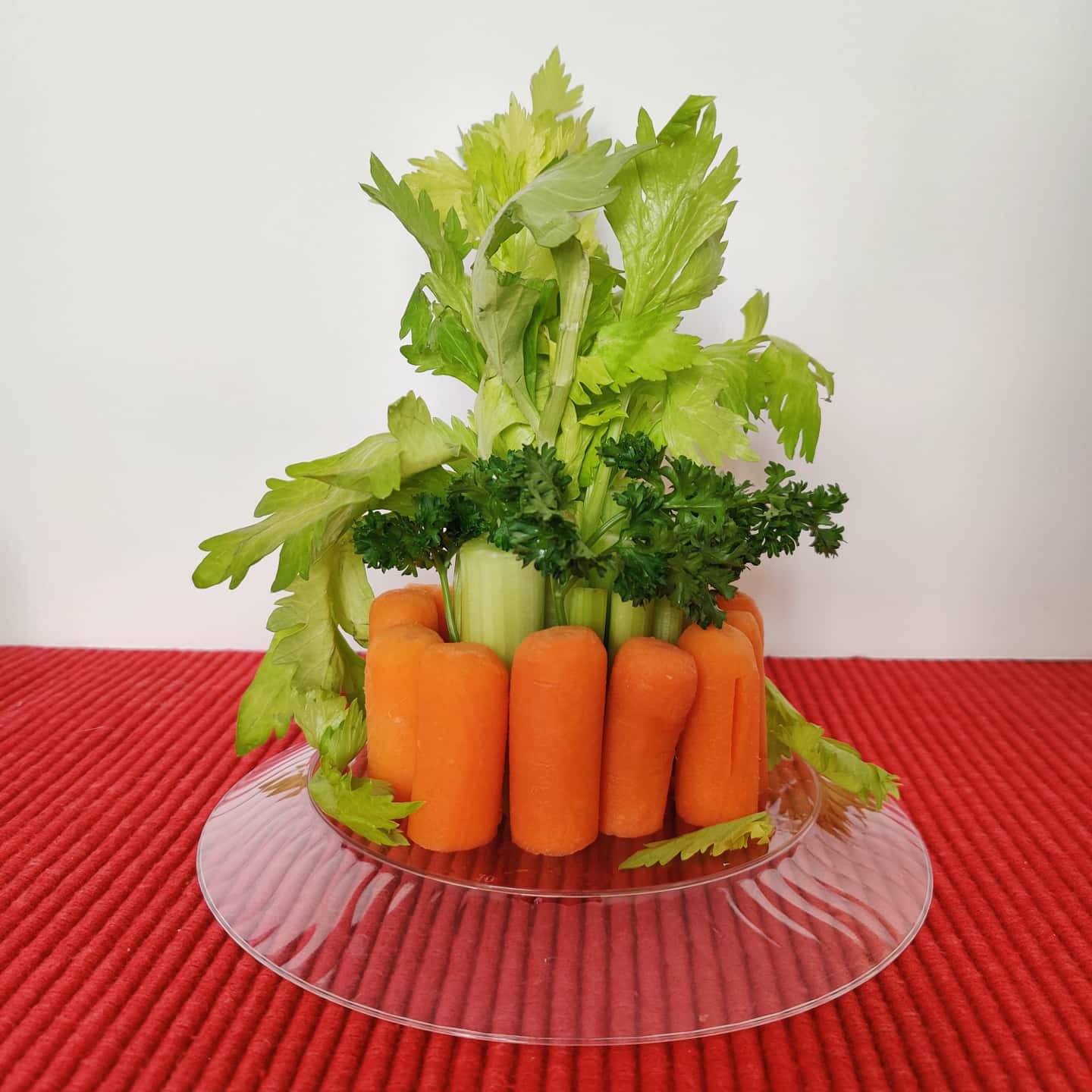
Here’s one we made:

Suggested Ingredients

  • Carrots
  • Celery
  • Parsley

You can also add any other favorite vegetables your bunny has!

Building Instructions

  1. Put down a small plate.
  2. Cut celery tops so the bottoms are level.
  3. Put a rubber band around the celery tight enough, so they stand up together. Feel free to add parsley to the bundle.
  4. Stand up the baby carrots around the celery to hide the rubber band.

Important: Make sure you supervise your bunny while they eat their homemade bunny “cake,” so they don’t eat the rubber band. Your bunny also doesn’t have to eat it all at once. Likely it’s more carrots than they should have in one sitting, so you can save some for another day (just like humans do on their birthdays).

Make your bunny the star with their own themed photoshoot

I always like to have a mini photoshoot for Baby’s gotcha day to help commemorate the moment.

It doesn’t have to be anything crazy, although I have seen some people go truly deluxe with their setup.

For this year’s shoot, I just went to the Dollar Tree and got some cheap decorations to use as background props.

Treat your rabbit with a birthday/gotcha day surprise gift

What’s a birthday or gotcha day without gifts???

Some years, I’ve gotten Baby just a small gift. But other years, I’ve gone all out! For one gotcha day, my family even joined in and got him some presents too!

Here are some ideas for your own bun that Baby has enjoyed on past birthdays:

Food

Toys

  • Baby keys
  • Baby rings
  • A stuffed animal (Just make sure your bunny doesn’t ingest any “fur” while grooming their new friend)

Habitat Upgrades

Spend quality time together

Last but certainly not least, spend some time together!

In the end, it’s not about the presents or the photos, but about the time you share with one another.

Take some time to get on your bunny’s level. Find their favorite spot and give them a good bun massage!

Cherish every moment you have with your bun!

Stay Connected

Sign up for our newsletter through Substack. We’ll send updates about our latest blog posts and projects, so you won’t miss a thing!
Note: As an Amazon Associate I earn from qualifying purchases. I get commissions for purchases made through links in this post.

cuzrabbits gets commissions from some of the affiliate links in this post. Support our education efforts by buying your pet supplies at Small Pet Select.

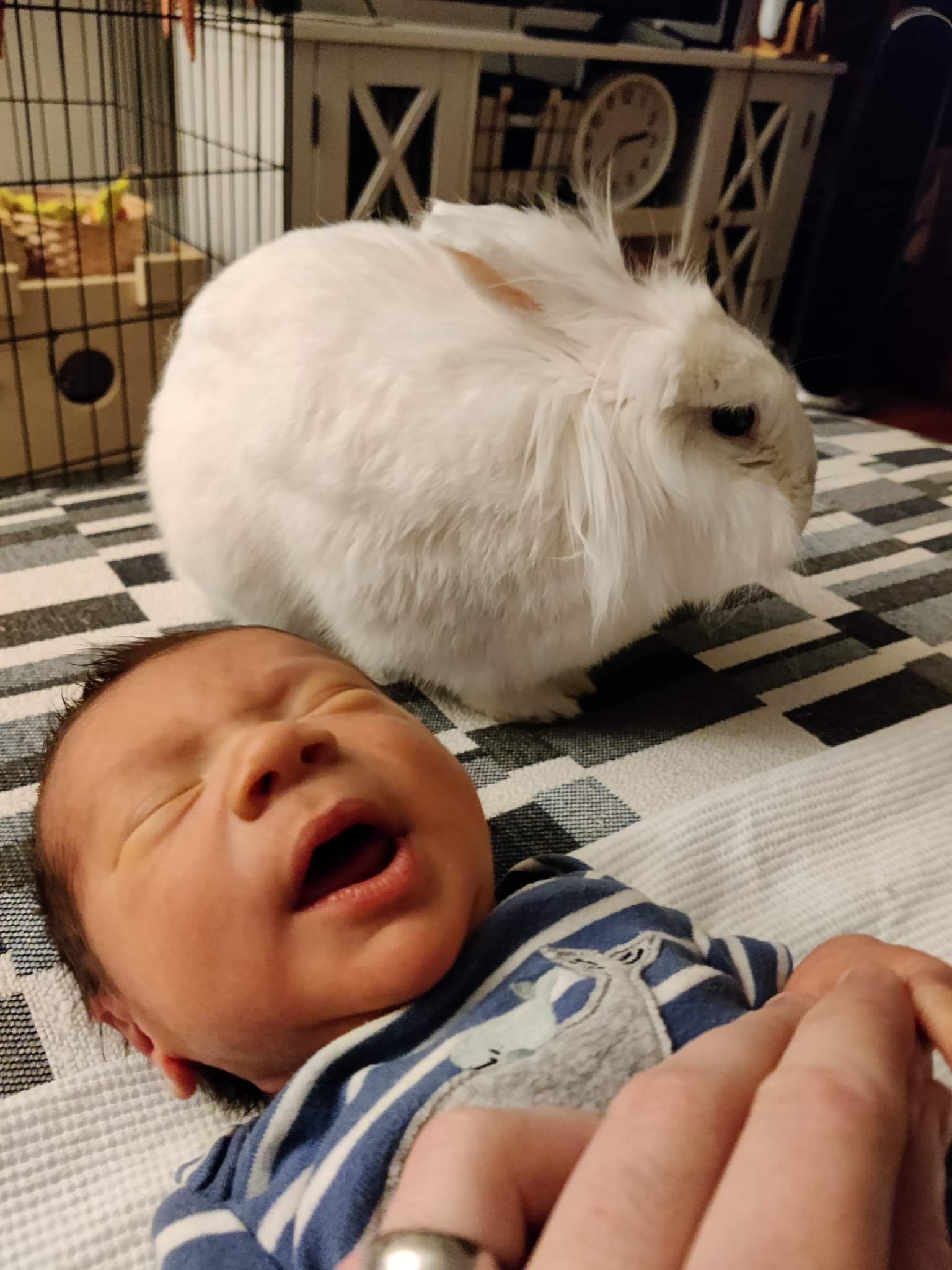
Warning! This is adorable! We introduced our rabbit to our newborn baby

Many people who know me in real life probably also know that my white lionhead, Baby, is my entire world.

I first got him off of Craigslist when I moved to upstate New York for my first post-college job. He was my greatest companion when I had none in a stranger new place away from family and friends. The only times we’ve been separated for more than a day have been for maybe one vacation and a few of Baby’s emergency hospital visits for GI stasis.

So when my husband and I found out I was pregnant, we were a little nervous about how our changing situation would play out.

Would we still have enough quality time to spend with Baby? I’d pet him for hours each day, especially since I worked from home and didn’t need two hands to click my computer mouse.

Would Baby be jealous? He’s been an only child so far and didn’t even love the idea of having another rabbit sibling.

Preparing Baby for the newborn and hospital stay

At about the 8 month mark of the pregnancy, my husband and I came up with an action plan for making sure Baby was taken care of while we were in the hospital.

Our usual babysitters, my parents, were more than willing to help out. And we had a note with care instructions ready to go.

We also wanted to include Baby in the lead-up to the birth. This included the mini photoshoots we did at home.

We had our baby in mid-February and spent two days in the hospital

We didn’t do much to prep Baby for the screaming of a newborn. Baby won’t flinch at my husband yelling while playing video games, but if I sneeze, it’s a total disruption to whatever he’s doing. We knew his reaction to a baby would ultimately be a toss up.

Checking in on Baby during the hospital stay

This was definitely one of those situations where I am 1000% grateful I bought a pet cam years ago.

During our two-day hospital stay, I was able to periodically check our Wyze cam to see how he was doing. He’s had a few bouts of stasis, so it was really important to me that I could still monitor him. Even though our absence threw off his routine anyway, I would at least be able to tell if he was eating the food my parents were dishing out.

It was absolutely adorable to see him eating hay, making a mess, jumping into his litter box, and napping. Even though I couldn’t be there with him, it took some of the anxiety away and made me feel like we weren’t forgetting him now that we had a human baby to worry about.

Coming home was a whole other adventure!

On the hospital, you at least get some breaks. They may take the baby away for 15 minutes here and there for testing, and bring him back nice and calm.

But at home, you’re on your own!

Our usual daily routine was completely thrown off, replaced by the needs of our human child. Between the screaming and the breastfeeding and the diaper changing and the burping, it was almost impossible to give Baby the real attention he deserved. Because the baby kept us up at all hours, there wasn’t really a start or end to our days. That meant we missed his morning puzzle feeder routine and barely made the late night veggie snack platter time.

The one trade-off was that we camped out in the living room. Because we could supervise him 24/7, Baby was able to start free roaming all the time. Typically he’d only free roam during the day (for his own safety), so this was a big upgrade for him.

At first, Baby was completely indifferent to our newborn. He was far more excited about us finally being home to let him out of his playpen. He did zoomies for about a half hour straight!

Slowly, Baby has been taking an interest, but it’s still very passive. If we’re changing our baby on the ottoman, Baby might come up to check it out. Or if he happens to be there already, he won’t be too bothered by the screaming.

Developing a routine that worked for our family

The first week or so, there was no routine. Everything was dictated by the hunger and bowel movements of our newborn. We couldn’t even get through a 20 minute tv show without having to pause five times (ultimately giving up entirely).

We tried to get to Baby as much as we could. Unfortunately shedding season must have begun while we were in the hospital, because his fur was just flying off!

After a week, things started to level out. Our newborn started sleeping for longer stretches, giving us a chance to breath. We were able to use some of those stretches to give Baby all the attention he wanted.

I could go back to petting him for 30 minutes at a time. We were also able to get back into our morning and night feeding routine again.

It wasn’t the same, but it’s what we could manage.

Trying our best

During the whole process, I felt so so guilty that I wasn’t giving Baby all the love he needed. I definitely cried a few times mourning our past life together.

I can only compare it to people who have multiple children and feel guilty they’re neglecting the emotional needs of their older children.

Having a human baby is a serious life change. It can take a while to adjust, and we’re still a work in progress ourselves!

Note: As an Amazon Associate I earn from qualifying purchases. I get commissions for purchases made through links in this post.

Never miss an article!

Processing…
Success! You're on the list.

Free Downloads: How to celebrate Valentine’s Day with your rabbit

February 14 is a day to celebrate all the people you love in your life! While some people send Valentine’s Day cards, others bake pink-frosted desserts.

Our pet bunnies don’t have to be left out of the heart-filled festivities!

Here’s how I’ve celebrated with my white lionhead bun, Baby.

Send bunny themed Valentine’s Day cards

Canva is a great design app you can use to design your own Valentine’s Day cards to print at home or at a store like Staples. They have templates already laid out for you to edit. You can also start your own card design from scratch.

Here are six free cards we designed featuring Baby and Pepper. Feel free to download and use!

Decorate your home with bunny and Valentine’s Day items

By this time of year, many stores have a mix of Valentine’s Day and early Easter products.

You can stock up on both or wait until the seasons are over so you can swipe up all the sales!

My favorite spot is Dollar Tree. I buy a bunch of things for home decorations that I can also use as photo props.

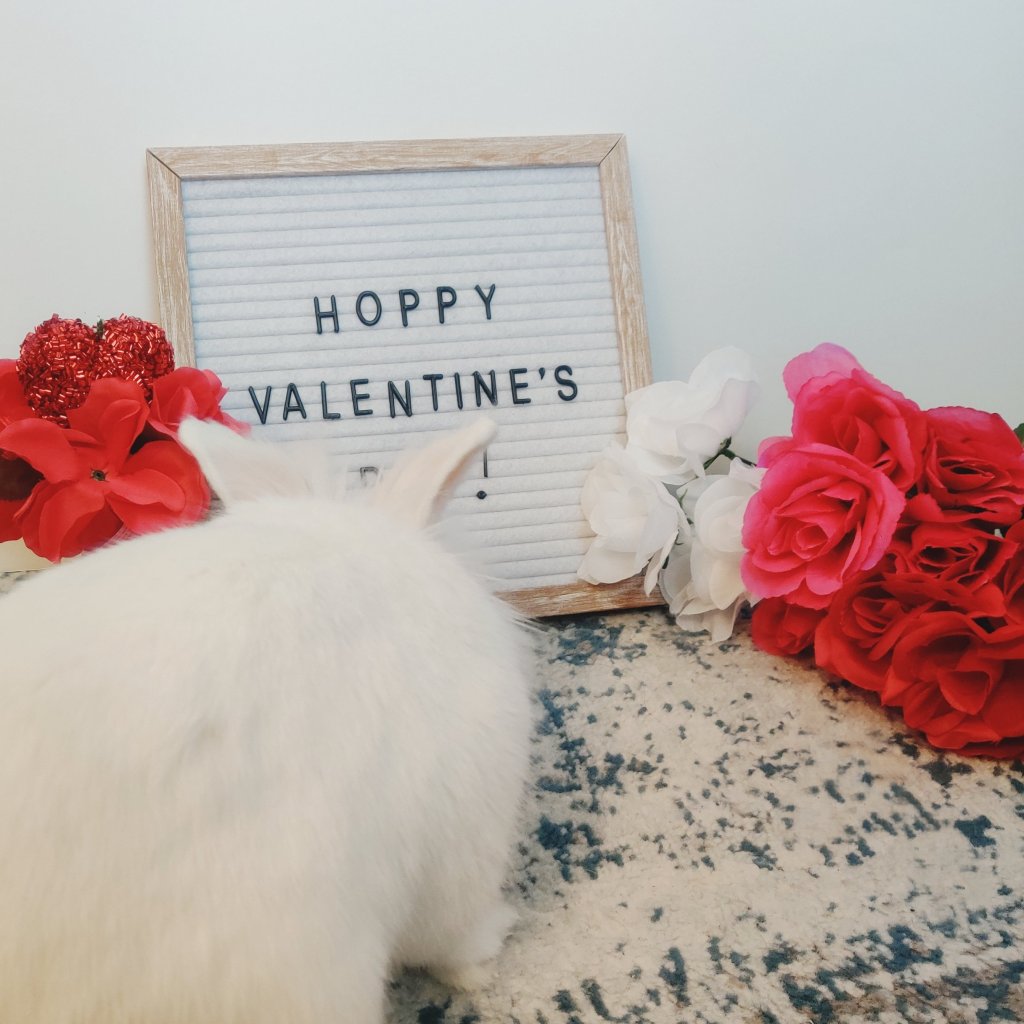
Have a Valentine’s Day photoshoot with your bunny

For most holidays and seasons, I try to do a mini photoshoot with Baby. He has a limited attention span, so I usually set everything up ahead of time.

Head to Pinterest and rabbit Facebook groups for ideas.

I’ll typically set up a cheap backdrop and throw in a few props for pizzazz!

Baby’s Photoshoot

We found some great props at the Dollar Tree this year. IT only took us about 15 minutes to set up and 15 minutes to take all the photos we need. It’s critical that you put your bunny first and make sure they’re comfortable during the experience.

Give your bunny a Valentine’s Day gift

Baby’s gotcha day is February 16, so he typically gets lots of gifts in February!

I typically get Baby his favorite treats, like papaya treats, and some fun extras, like Small Pet Select Herbal mixes.

Whatever snacks you choose, just make sure the treats are safe for rabbits.

Besides food, I also like to give Baby physical gifts.

Here are some ideas I’ve gotten for Baby over the years:

Spend quality time together

Nothing says “love” like spending some time with your bunny!

This could be an hour of petting and snuggling, teaching your bunny some new tricks, or just watching a movie together.

Just show your bunny you love them!

Note: As an Amazon Associate I earn from qualifying purchases. I get commissions for purchases made through links in this post.

cuzrabbits gets commissions from some of the affiliate links in this post. Support our education efforts by buying your pet supplies at Small Pet Select.

Get cuzrabbits updates!

Processing…
Success! You're on the list.

No Green Thumb Needed: How to grow vegetables indoors for your rabbit

You don’t need a green thumb or even summer weather to grow your own vegetables!

Whether you want to go the cheap route or invest in a full fledged grow system, there are plenty of options out there.

Here are some of the ways you can provide some greens for your pet rabbit.

Beginner: Regrowing Lettuce from the nub

This is the easiest thing you can do to grow your own rabbit veggies! All you need is a nub of romaine lettuce and a jar of water you can stick it in.

It won’t necessarily grow back into a full head of lettuce, but it’s something!

Once you’re happy with the bit of growth, you can give the whole thing to your bun.

Intermediate: Growing grass from a kit

There are kits your can buy that allow you to grow grass year-round.

This is a great option if you don’t want your rabbit running around in a potentially RHDV2-infested backyard.

Grass seed is easy to come by at your local garden store. But if you don’t want to invest in a giant bag of seeds, you can opt for Small Pet Select’s Pet Greens Medley. It comes in a 5 oz. bag and gives you a mix of organic oat, rye, and barley blades.

Pro-level: Growing veggies in trays, boxes, or high tech systems

Keep things simple with small starter seed trays. Things like this are generally lightweight and costs less money, so it’s lower risk if you find your in over your head!

Take it up a notch with an indoor herb grow kit in a wooden box you can put on a sofa table or on a wide window sill.

If you want to get really fancy, you can invest in an official looking system with a grow light attached. You can grow anything from parsley to basil in this bad boy.

Avoid my veggie growing mistakes

It can be easy to grow your own vegetables, but there are some mistakes I’ve made along my growing journey.

  • Don’t forget about your plants: This is one I am very guilty of. While your plants might not be as demanding as your pet bunny, make sure you don’t forget about your plants for two weeks! Your vegetable plants still need water and attention.
  • Don’t let your plants fry: Make sure the place you put your plants isn’t a death trap. I found out the hard way that my sunroom gets way too much direct sunlight. It only took a day for some of my plants to fry.
  • Don’t put your set-up within reach of your bunny: Obviously you’re growing your vegetables for your rabbit. But if you’re not careful, your bunny can jump his way to your growing station before the veggies are actually ready.

Note: As an Amazon Associate I earn from qualifying purchases. I get commissions for purchases made through links in this post.

cuzrabbits gets commissions from some of the affiliate links in this post. Support our education efforts by buying your pet supplies at Small Pet Select.

Never miss an article!

Processing…
Success! You're on the list.

How to decorate your home like a truly obsessed bunny parent

It can sometimes be difficult to find rabbit home decor that truly shows the world how much you love those furry creatures.

Stores, virtual as well as brick and mortars, seem flooded with cat and dog decorations.

But it is possible to find some cute bunny items!

Over the years, I’ve accumulated some cool items, although I’ve definitely had to hold back to stop myself from looking too much like a crazy bunny lady!

Here are some ideas for your own home:

Buy cute bunny prints

Nothing says I love rabbits like having paintings and prints of bunnies all over your home. It’s also one of the easiest and cheapest way to incorporate your beloved pet in your decor.

You can literally snap a photo on your phone and print it at Walmart for less than a dollar. And you can get cheap frames at a dollar store or thrift store.

You can find prints in all different styles, from traditional to minimalist.

Commissioning a painting or print of your rabbit

Etsy is a great place to find someone who can turn your bun into a work of art.

Some will photoshop your bunny’s head onto a traditionally painted human. Others can put paint them using watercolor or cartoonify your rabbit.

When ordering, just make sure you look at reviews to make sure other people were happy with the work (especially if you’re using a smaller shop). You’ll also want to make sure you’re clear on whether you’re getting an actual picture in the mail OR a digital file sent to you electronically.

Here are some options I found:

Buying cute rabbit prints

If you don’t necessarily want a representation of your specific rabbit, you can always get some adorable artsy prints of rabbits online.

This options allows you to get a piece that fits the fit and aesthetic of your decor. You can also make the art a little more subtle if you don’t want your place to scream “rabbit lover.”

For example, if you’re going for a more cottagecore feel, you can get a set of four bunny prints like this:

And this is a cute option for a minimalist/monochrome style home:

You can also get prints of your favorite rabbits like:

Incorporate bunny themed decor pieces into your home

You can add subtle touches of rabbits throughout your home!

If you opt to shop in physical stores, make sure to catch the after Easter sales. I’ve been able to find such good pieces for 50%-75% off! Buying a bunch of items at the same store will also help your finds have a more cohesive look when you put them in your home – since stores seem to have a general theme they’re going for each year.

Thrift stores are also a good place to find rabbit decor. Beware though, some of the bunny figurines I’ve seen could haunt dreams. I don’t know why, but for some reason, it seems like people have a difficult time making rabbit eyes not look creepy.

Kitchen

I love the rabbit themed kitchen towels I got on sale one year. They are, of course, the designated “good towels” that we don’t actually use!

You can also find bunny themed appliances, like this mini waffle maker that imprints a bunny onto your breakfast treat!

Or go small with a Lenox bunny salt and pepper shaker set.

Because of Alice in Wonderland, there are also a number of rabbit wall clocks out there.

Living Room

There are plenty of small finds that can liven up your room bunny-style!

I was gifted this Lenox bunny candle, and I’m obsessed!

You can add some bunny bookends to your shelves or decorate your end table with a lamp featuring snoozing bunnies.

I absolutely love this ceramic rabbit cake stand. I initially bought it for my wedding, but now I use it as a display for my wedding tiara. You could also use it for an actual dessert, of course!

Bedroom

A lot of bedroom rabbit decorations are geared towards nurseries, but there are options for adults.

This is where you can get really cozy with your decor by putting bunny themed pillows on your bed!

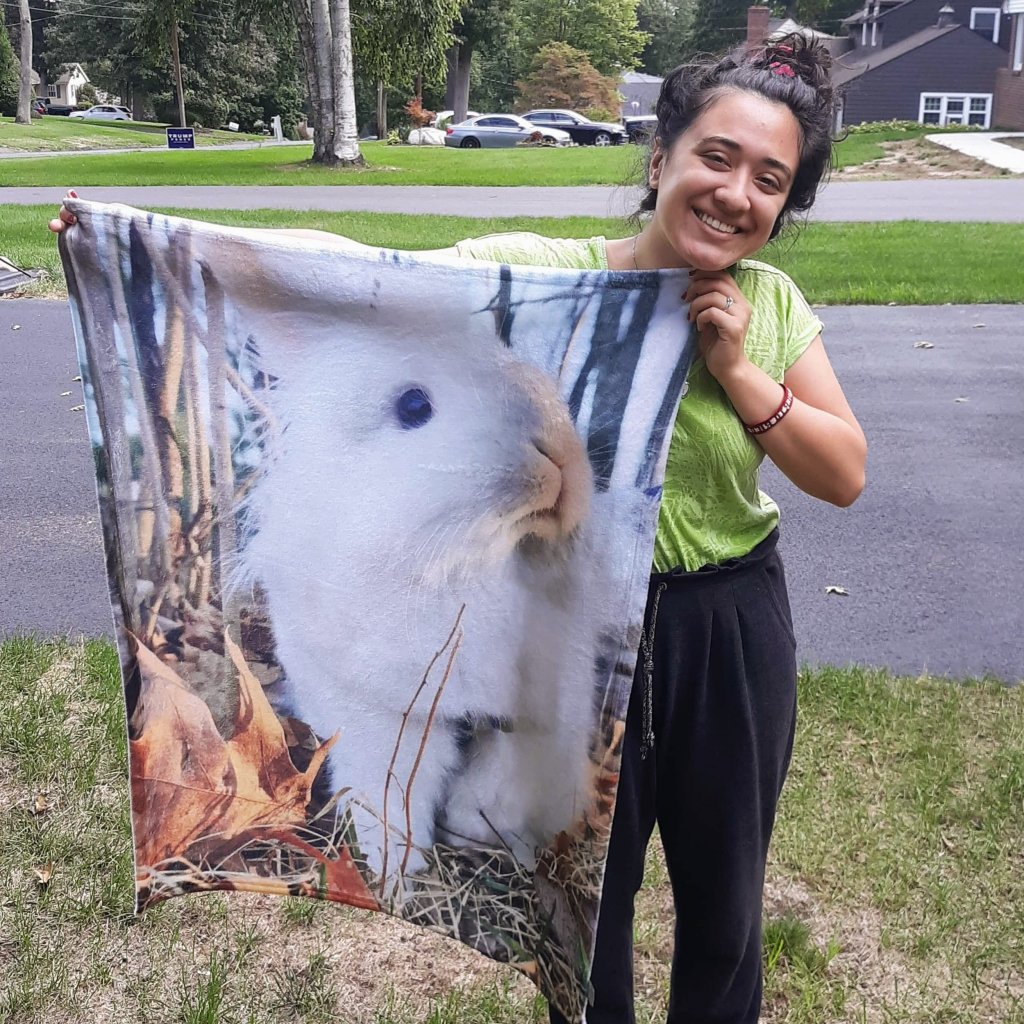
You can also use apps like FreePrints Gifts to turn your photos into your own creations for your home. I turned one of my favorite photos of Baby into a blanket!

Rabbit ring holders also look adorable on your nightstand. I bought my sister one like this for my sister a few years ago.

You can also stick a cute bunny nightlight on your nightstand.

Outdoors

Alas, I live in an apartment so I don’t have a yard to decorate.

But if I did, you know I’d have this magical rabbit statue somewhere peeping out of some flowers!

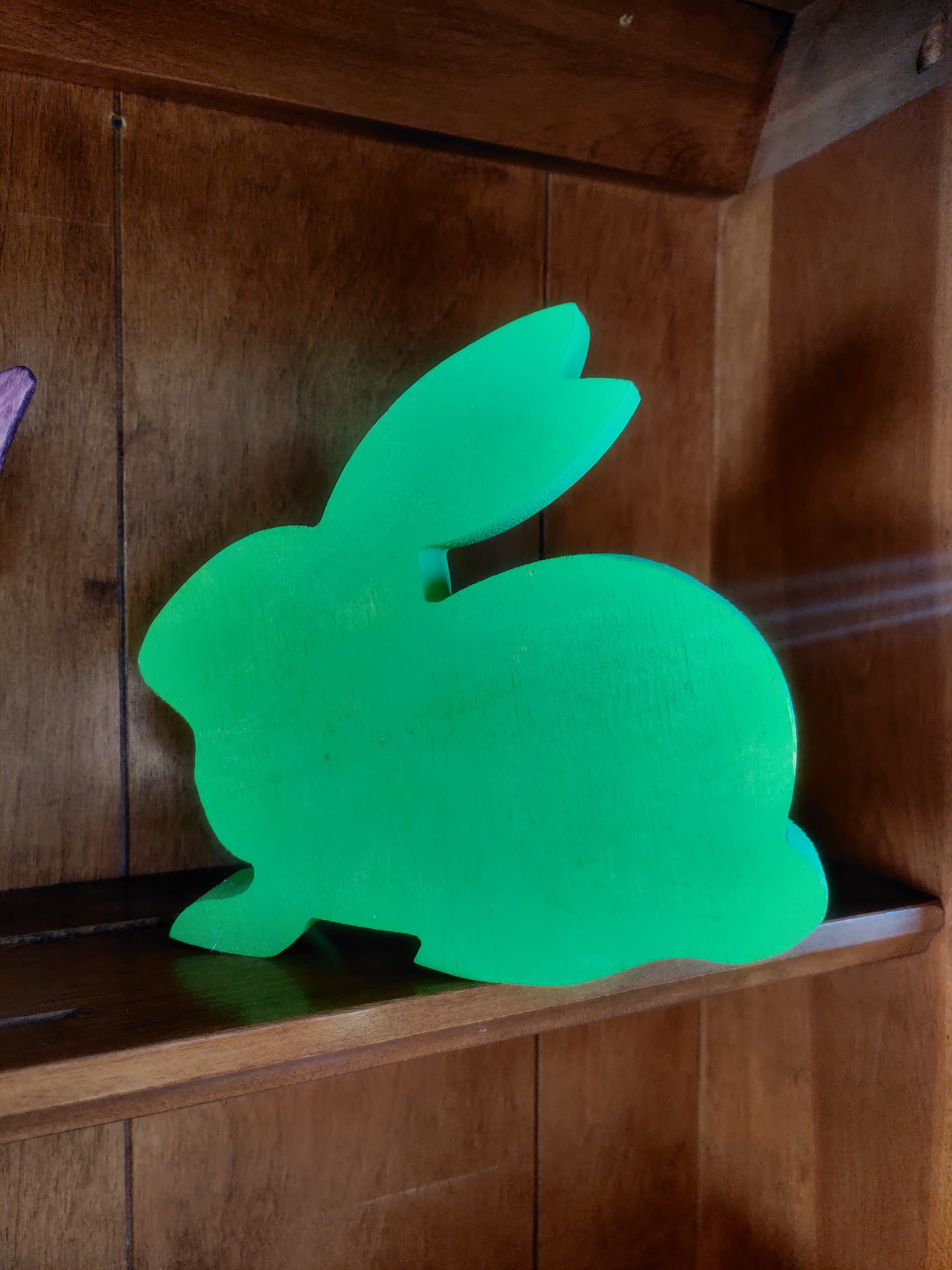
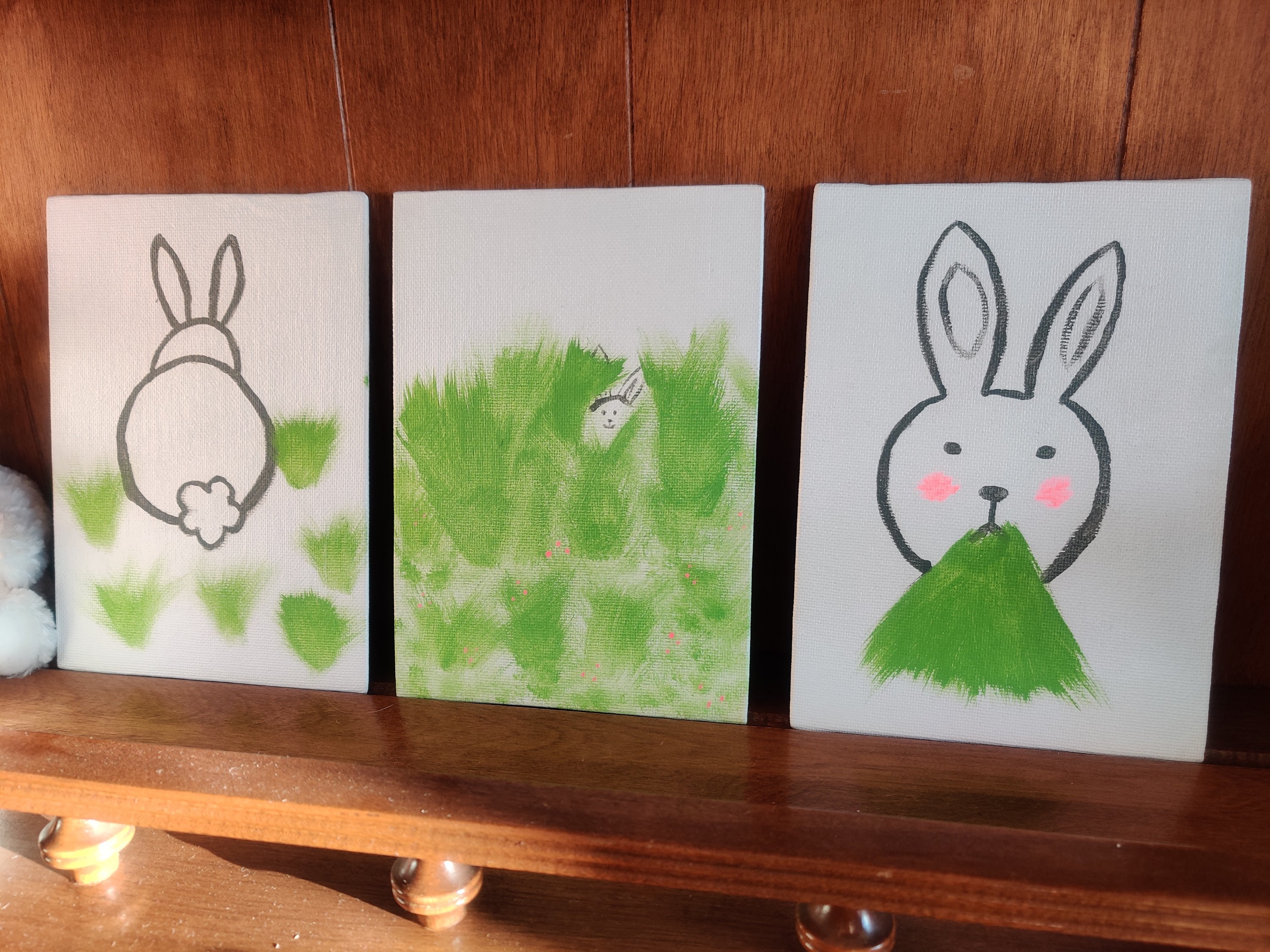
Get crafty!

You can also create your own rabbit decor.

Here are some of the creations my sisters and I have made over the years!

Some of definitely better than others!

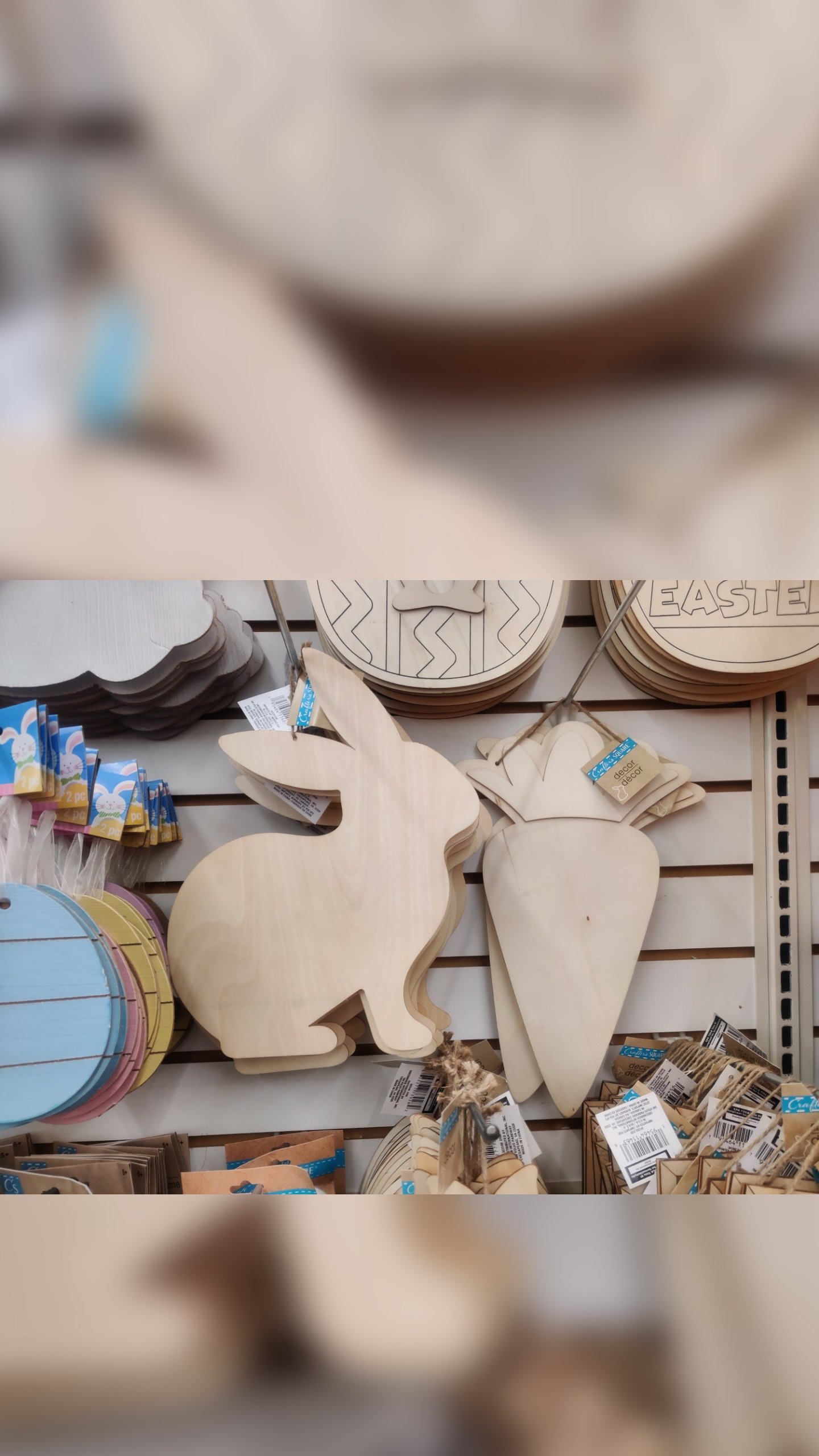
You can find materials at different dollar stores before and after Easter. You’d be surprised at how much cute crafting things you can find for cheap!

Make it your own!

In the end, it’s your home.

Decide what level of rabbit-crazy you want to achieve and just go for it!

Note: As an Amazon Associate I earn from qualifying purchases. I get commissions for purchases made through links in this post.

Never miss an article!

Processing…
Success! You're on the list.

How to take great photos and videos of your rabbit

Photos are some of the best ways to cherish memories with your pet rabbit. Even when they cross over the rainbow bridge, you can look back on all the cuteness they had to offer. I love seeing pictures of some of our past rabbits when I check Facebook memories or look at old Instagram posts.

Some may find it difficult to capture those special moments.

The good news is, you don’t have to be a pro to take good photos of your bunny.

Here are some of my tips for getting the shot!

Things to keep in mind when setting up your shot

Anyone can take good photos with a little effort and planning!

Use natural light when possible

Bad lighting can ruin any photo or video. From my experience, it’s very difficult to get a good shot in low lighting. Everything ends up looking grainy and blurry.

If you can, try to shoot in the mornings or a little bit before sunset. You may even catch the “Golden Hour,” when the sunlight hits just right and gives the shot a magical feel!
You can use a full size ring light or a ring light that attaches to your phone if you really want to shoot in low light.

I wouldn’t recommend using the flash. I find that it’s too harsh and makes the photo look shadowy. It also doesn’t distribute light well, so seems to aggravate Baby more.

Check your focus

Besides bad lighting, nothing wrecks a photo quite like blurriness. The only good blurry photo is one done for comedic effect to show an especially fast zoomie!

Make sure your lens is focused on your rabbit. For most phones, this just means taping your bunny on the screen.

Get on your rabbit’s level

I find the best photos come from getting low to the ground. It makes for a cuter photo than a far off photo from a bird’s eye view.

It also helps you get close-ups of cute rabbit features like their soft paws and their cute little nose!

What equipment do you need?

You don’t need a expensive DSLR camera to get a good photo or video of your rabbit. Most smart phones and tablets nowadays have create cameras already built in.

I just use my phone to take photos. I’ve found the OnePlus line of phones is cheaper than many other options but still has great camera quality.

That being said, there are some extras you can buy to take your photos to the next level.

Consider getting a pet cam

I’ve found that pet cameras are so helpful!

First and foremost, they are great tools to incorporate into your rabbit care. I first bought a pet camera several years ago so I could check up on Baby while I was at work. Since then, I’ve used it during medical recovery times to make sure he was eating and pooping consistently. One time, I was even able to pinpoint the timeframe when Baby hurt his front leg by comparing videos taken by the pet camera at different times.

The other good thing about having a pet camera is that you can capture more candid photos and videos of your rabbit without all the extra effort. Just look through the recordings! You’ll be able to save screenshots or video recordings of nighttime zoomies and daytime shenanigans.

I use the Wyze Indoor/Outdoor Camera. It’s small enough that I can easily bring it on trips or mount it discretely in my apartment. It’s also easy to set up and the most reasonably priced camera I’ve come across.

Make a backdrop on a budget

I make cheap backdrops by clipping pieces of fabric to white foam boards. You can find these at most dollar stores.

It makes it easy to switch out backgrounds without having to buy those full sized backdrops designed for professional photography.

Buy cheap props

Make sure you supervise your rabbit if you’re using props. The last thing you want is your rabbit to accidentally eat something they shouldn’t.

Props aren’t necessary, but I use them to add another element of cuteness in some of my photoshoots with Baby.

I’ve found most of my seasonal decor at dollar stores. You can also find unique items at tag sales. One thing I look for are items made for 18-inch dolls, like American Girl furniture. They also happen to be the perfect size for rabbits!

Don’t get discouraged

Rabbits have a mind of their own, so don’t be shocked if your rabbit doesn’t sit nicely for a 30 minute photoshoot. It’s important to be patient with your bunny. They’re not a professional, and they’re just trying to live their best bunny life.

There are some rabbits I’ve seen on social media that seem like statues. They let their owner dress them up in cute outfits and even make them dance by holding their paws.

I know Baby would murder me if I even thought about doing that, so I don’t bother. Most of the time, I just wait to catch him in his natural environment, doing his cute daily activities.

Here are some things I do to make an actual photoshoot easier on Baby:

  • Set up in advance: Make sure you have everything ready before you bring your rabbit over. You don’t want to be fumbling around, waiting valuable bunny attention span and time.
  • Use food: If your rabbit is food motivated, keep a pellet or two in your hand so you can redirect their attention. I’ll sometimes drop a pile in the middle of the photoshoot space and snap photos when Baby picks his head up to chew.
  • Don’t force it: Take your cues from your bunny. If they’re not having a good time, you’re basically torturing your rabbit “for the ‘gram.” Take a break or wait to take photos another day. The pictures will be better anyway if your rabbit is calm and in a good mood.

Take your time and make sure your rabbit is comfortable.

Storing Photos

Once you have your photos, make sure you don’t lose them!

I try to make sure I backup the photos on my phone to a hard drive every few months. That way if something happens, you’re not losing all your photos.

You can also use cloud storage like Amazon Photos Storage, which comes free with an Amazon Prime account.

Or you can go old school! Print out your photos and make a photo album you can flip through.

Just have fun!

Through this whole process, try not to stress about it! Getting a “perfect” shot can take time.

Remember the reason you’re doing all of this — hopefully because you love your bunny and want some good memories captured.

Worst case scenario, you could always get in contact with a professional pet photographer and schedule a shoot!

Note: As an Amazon Associate I earn from qualifying purchases. I get commissions for purchases made through links in this post.

Never miss an article!

Processing…
Success! You're on the list.

Avoiding the nightmare: How to prevent GI stasis in pet rabbits

GI stasis is something I wouldn’t wish on my worst enemy.

It’s an ugly, silent killer that can turn your life upside-down in a matter of hours. It’s left me curled up in bed crying my eyes out as I’ve waited for a call from the vet.

Baby and I have dealt with GI stasis three times. I’ve had to do a lot of research and develop a plan to keep Baby out of the hospital.

Here are some answers to common questions about GI stasis, how vets treat GI stasis, and our prevention plan.

What is GI stasis?

GI stasis is a digestive issue. Food slows down as it goes through your rabbit’s GI tract. This slowing or stopping altogether can cause bad bacteria to build up. That bad bacteria then makes a gas that builds up painfully. It makes the issue worse because a rabbit in pain doesn’t like to eat or drink.

Rabbits basically need to eat ALL THE TIME to keep their gut healthy, so this slowdown can be disastrous.

What are the symptoms of GI stasis?

Because Baby has had GI stasis three times already, we can tell almost instantly when he has it.

He’ll hunch up in one corner and refuse to move even when we crinkle a treat bag. When I’ve tried to forcibly move him along, I’ve noticed he has peed just a tiny bit.

It’s important to have an established routine with your rabbit. That way you’ll be able to quickly tell if something is “off.” We know that if Baby isn’t done with his afternoon nap by 5 p.m., we should do a check in with him just in case.

You should also groom/pet your rabbit often so you can identify a change in their stomach. The first time Baby had stasis, I was able to feel that his stomach seemed a bit harder and bloated than usual.

Look for these signs in your own rabbit:

  • Refusing to eat or drink
  • A lack of poop or much smaller poop than usual
  • Hunching up (one cuzrabbits reader said her bunnies push their bellies to the floor instead when they have stasis)
  • Grinding of teeth (this is different than the happy “grinding” you may hear while petting your bunny)
  • Looking like they’re in pain
  • Feeling a hardness or swelling in their stomach

Why do rabbits go into GI stasis?

There are a number of reasons a rabbit might go into GI stasis:

  • A bad diet: Rabbits need a low starch, high fiber diet. That means more hay, less pellets.
  • Stress: Some rabbits don’t handle things like changes to their environment, loud noises, or travel.
  • Other health issues: When a rabbit is in pain from something like overgrown teeth or arthritis, they can stop eating.
  • Blockage: Something may be blocking your rabbit’s digestive tract, like a clump of hair, pieces of fabric, or cardboard.

What do you do if you think your rabbit has GI stasis?

GI stasis in rabbits is an emergency.

Go to the nearest emergency exotic veterinarian hospital near you.

While some people have successfully treated GI stasis on their own, I do not recommend it.

Unless you’ve been to vet school, you’re not an expert. For all you know, your rabbit may actually have a blockage of hair or cardboad — which means force feeding critical care will only make matters worse.

What will a veterinarian do to treat GI stasis?

Each time Baby had stasis, the treatment followed the same pattern:

  1. First Evaluation: Baby was taken in to be evaluated. In this stage, they checked Baby’s vitals to see if he needed immediate emergency care or if he could wait in line with the other emergency pets that needed care.
  2. Incubation, hydration, and medication: Baby always ended up having a lower temperature than they wanted. He was also dehydrated, so they’d give him an IV. The IV hydration is supposed to help loosen any blockage that may be there. They’d also start giving him pain medication and motility drugs (to get the digestive system up and working again).
  3. Overnight monitoring: Baby’s emergencies always happened after 5 p.m. He never recovered fast enough to be released that same night.
  4. Suctioning: A few of the times Baby was hospitalized, they had to try to suction out the blockage of fur.
  5. Daytime check-ins: The vet in charge will typically give you a status update in the morning. No news is good news in this case, so don’t worry if they’re a bit late with the call. Depending on how busy the staff is, they may send you photos of your bunny in their recovery nook.
  6. Monitoring until better: Baby has always had to stay in the hospital for multiple days. The vets are essentially waiting for 50 poops in one day as well as consistent eating a drinking. We’ve been held up by Baby only pooping 15 times. Better than nothing but still not good enough for the vets to feel comfortable sending him home. After a few days, we were given the choice of taking Baby home if we were desperate. They trade-off is that if he got worse again on the 1+ hour car ride back home, we’d have to turn right back around and readmit him — starting the process over.
  7. Release: Once Baby was better, they’d set up a pick-up time. They were pretty flexible with the timing.
  8. Home care: The vet prescribed Baby pain medication and motility drugs for use to give him at home via syringe. We also had to buy Critical Care to syringe feed time three times a day. Make sure to follow whatever instructions your vet gives you.

What will the vet do if your rabbit has had multiple cases of GI stasis?

Our emergency veterinarian decided to do some testing when Baby had GI stasis more than once.

They took bloodwork for testing and tried to see if he had E. Cuniculi. It’s a parasite that can cause issues with your rabbit’s nervous system and can be an underlying cause of GI stasis. For Baby, the tests came back negative.

They also took an X-ray to see if they could find anything odd in his system. They didn’t see anything wrong in Baby’s scans.

Their other theories were that maybe he is starting to develop arthritis and just isn’t grooming as often as he used to during shedding season. If that’s the case, when he does groom, he’ll end up picking up bigger chunks at a time, which could lead to a blockage.

The discouraging thing about GI stasis is that sometimes you won’t know the exact reason for it. There’s no guarantee it won’t happen again. All you can do is try your best to be an amazing bunny parent.

What is the cost of treating GI stasis?

Each time Baby had stasis, the total bill came out to be between $2,500-3,000.

That is a hefty sum of money.

We paid for the first case with the emergency fund we had been creating for Baby. Each month, we put in about $100-200 in the bank account.

We funded the second and third trips to the hospital with money from stimulus checks, tax returns, and more of the money we’d continued to save each month.

Not everyone has that kind of money available to them.

BEFORE an emergency strikes, I recommend getting exotic pet health insurance through Nationwide. They’re the only insurance company in the United States that covers rabbits. DO NOT wait until after your rabbit’s first GI stasis incident because then it will be considered a preexisting condition. I’ve heard you can get your pet’s case reviewed after 6 months of being stasis-free, but we haven’t gotten to that point yet.

Our GI stasis prevention strategy

My husband and I have developed a plan with the help of our primary care veterinarian to prevent GI stasis.

As cute (but mostly horrifying) as Baby looks with a shaved leg from the IV, we definitely don’t want a repeat episode.

That being said, we can only do the best we can. Nothing is a guarantee.

Food

Baby has constant access to fresh timothy hay. Because I work from home, I’m topping off his bin every few hours. You can also mount a hay feeder to your rabbit’s playpen.

My husband feeds Baby a few papaya treats each morning, breaking them into smaller chunks. Papaya is supposed to help break down hay in his stomach.

We’ve also started giving him one Oxbow Natural Science Digestive Support each night before bed.

One of the biggest changes? We’ve significantly limited the amount of pellets we feed Baby each morning. Our primary vet told us rabbits technically don’t need pellets at all. They were primarily used to fatten up rabbits being raised for meat, but obviously we have no need for that. Now I just give baby maybe ten pellets each morning — but I put them in a puzzle feeder to make him eat slower and use his nose.

Grooming

My husband and I wake up at different times, so we each have separate morning grooming sessions with Baby. I also end up petting and grooming him for at least an hour each night as we watch TV or hang out in the living room.

Besides the normal petting, we go in and really try to make sure we’re picking out loose chunks of hair. Every bit helps and means less going into his stomach.

We’ve also invested in a Small Pet Select HairBuster. It’s great for the longer sections of hair on his mane. Here’s our full review of the HairBuster.

Limiting harmful materials

We’ve also taken out any cardboard from his area that he could potentially injest. When he was younger, Baby would just shred cardboard boxes as he made tunnels. But we started to notice he was eating more of the bits. We just don’t want to take a chance that it will cause a blockage.

We also don’t give Baby any cloth items for the same reason. He tended to start eating at the blankets. So now he just has access to the couch blankets, and we’re around to supervise and tell him “no.”

Exercise

We’re still working on this part of the plan, but our vet suggested we help Baby become more active.

This could be anything from training him to do tricks to having him participate in agility exercises.

Years ago, I built one of those jumps like the ones horses use in competitions. But it was definitely a rough build, and my family all voted the nails on it were a hazard! So I’m on the look out for something a little more safe to invest in.

When I had makeshift jumps (make out of dowels and empty tissue boxes) was able to train Baby to go over 2-3 jumps in a row though. He is very treat motivated, so he was all for the extra activity with pellet rewards were involved.

I bought Baby a new collapsible cat tunnel for Christmas, so I’m hoping to incorporate that in a course once I have everything I need!

Regular vet visits

We make sure to take Baby to the vet at least once a year.

This time around, our vet wanted to make sure the GI stasis wasn’t stemming from a teeth issue. Apparently that’s common in lionhead rabbits. Baby seemed to have a little bit of an issue, but the vet said it was only an issue if the growth was significant in six months. So we’re going back in early spring for another checkup.

Have a Plan

The emotional toll of a GI stasis incident is great. Not only can it put your rabbit’s life in danger, but it also reeks havoc on their human parents’ emotions.

Make sure to know the signs of GI stasis and know which exotic vets are open at which times. The last thing you want to do in an emergency is waste time calling around to find a location open 24/7.

You also want to take preventive action.

Do you have any GI stasis advice for rabbit owners? Leave a comment to let people know your tips and tricks for navigating this horrible health issue.

Note: As an Amazon Associate I earn from qualifying purchases. I get commissions for purchases made through links in this post.

Stay Connected

Sign up for our newsletter through Substack. We’ll send updates about our latest blog posts and projects, so you won’t miss a thing!